Jump to:
What is a bioregion?
A bioregion is a part of the earth defined not by arbitrary human boundaries but by ecological patterns. A watershed is a type of bioregion that is commonly referenced, because it is easy to define and clearly aligns with a particular pattern, but it is far from the only type. Bioregions have several features that distinguish them from conventional political states:
- They are for everyone, in the broadest sense. Centering the land reminds us of our connections to all beings who share it, have shared it, and will share it—including our human ancestors and descendants, as well as the plants, animals, fungi, and other organisms with whom we exchange the matter and energy of life.
- They overlap. A citizen of Jamesland (the bioregion corresponding to the James River watershed) may or may not also be a citizen of the Piedmont (the bioregion corresponding to a physiographic province stretching from Alabama to New York). I can claim membership in an indefinite number of bioregions based on different, interweaving ecological systems.
- They are fractal. As a citizen of Jamesland I am also a citizen of the larger Chesapeake Bay bioregion, along with residents of the Potomac, Susquehanna, and various other watersheds. At the same time, I am a citizen of the much smaller Blackwater Creek watershed that encompasses some fifty square miles around my home. Political states imitate this in their delineation of states, counties, etc., but in a fractal system like the hierarchy of watersheds, the patterns in each smaller component naturally reflect the whole.
- They are fuzzy. Bioregional boundaries are not set in stone. Even a relatively “solid” line like a watershed boundary will shift over time as a river erodes a mountain, sea level rises, or one stream captures another. In flat swamps, along tidal rivers, or in karst landscapes where water moves freely underground, any lines drawn based on the flow of water can only be approximate. Citizens of a bioregion must learn to live with this indeterminacy.
- They are aligned with natural flows of energy. Conventional political states have often treated natural features like rivers as boundaries. This divides people who have built a shared culture around these features, and who share the impacts of environmental change. It also causes problems (see the escalating “water wars” of the twenty-first century) when governments are asked to collaborate across these lines to manage resources. To take my home state of Virginia as an example, consider how much residents of suburban Alexandria have in common with their Maryland counterparts just across the Potomac; now consider how little they have in common with the residents of Big Stone Gap, deep in Appalachia in the state’s far southwest. Our administrative boundaries are badly misaligned with the things that matter to these people. By placing a river at its center, as indigenous nations so often have, a watershed bioregion gives its citizens a focal axis that can be seen and felt–endowing them with a shared basis for culture and a shared responsibility for stewardship.
What is a nation?
We use the term nation loosely, as an imaginative and inclusive way of cultivating community among all beings who inhabit this land. It is not meant to imply any political system, it is not meant to endorse any sort of separatist movement, and it is not meant to equate us with any other community using that term. That includes the Indigenous nations located in Jamesland, for whom terms like this have often been fraught as they have struggled to gain formal recognition from the United States government. (At present four of these are federally recognized: the Monacan Indian Nation, the Nansemond Indian Nation, the Chickahominy Indian Tribe, and the Chickahominy Indian Tribe—Eastern Division.) The “nation” we are exploring here is not an exclusive institution with a qualifying test, but an open-ended body in a perpetual state of becoming.
Why Jamesland?
Like so many of our American places, the James River was named in honor of an absentee colonialist ruler, King James I of England. We recognize that perpetuating this name is not ideal, and yet we also recognize that over the centuries the river has claimed this name as its own: the average schoolchild in Richmond or Norfolk could tell you next to nothing about King James, and a great deal about the waterway that binds them together.
Some bioregional initiatives have adopted Indigenous names as a way of honoring those with prior claims to the land. The ethics of decisions like this have been questioned at times, although it is possible to make them with sensitivity and in dialogue with native voices. (For more about the pitfalls of bioregionalism, this is a good starting point.) In any case, no Indigenous name has survived that corresponds to the James as a whole or its surrounding area. At the time of contact this area was inhabited or used by speakers of three language families (as different as English, Mandarin, and Arabic).
Powhatan, an Algonquian word, is the first name on record to be associated with the river. (The general term for “river” in the Algonquian Powhatan language is yeokanta.) Before the Jamestown colonists planted a cross at the Fall Line and renamed it “Kings River” (on May 24, 1607), they referred to it as “Powhatan’s river” after the paramount chief of the surrounding lands. Chief Powhatan, born Wahunsenacawh, had in turn taken the name of his village of origin. It is not clear whether the region’s Algonquian speakers had traditionally used this name for the river; in any case the name is now already in use for a town and county of Virginia.
Algonquian names for the basin’s three physiographic regions, now adopted as provinces of Jamesland, were recorded by the 17th-century explorer John Lederer. Ahkynt was their name for the coastal plain, Ahkontshuck corresponded to the Piedmont, and Paemotinck was the highland region (with Quirank another name recorded for the Blue Ridge in particular).
Tsenacommacah was the name given to the lands covered by Chief Powhatan’s confederacy. These extended far beyond the James basin to the north, spanning most of what is now Tidewater Virginia and parts of that state’s Eastern Shore, but they did not extend beyond the Fall Line to the west.
No name for the river or the region has survived from the Siouan speakers who lived in the Piedmont at this time. The name of their dominant tribe, Monacan, has been translated as Siouan for “people of the land” or “people of the water,” and also as an Algonquian appellation meaning “earth diggers.”
The Iroquoian speakers who made opportunistic use of the Great Valley are thought to have referred to the upper James (or perhaps its tributary the Maury River) as Galudoghson. The meaning of that name is not known.
Who are we?
The Nation as of yet has no formal organization, membership, or agenda, although the hope is that it will inspire many collaborations and initiatives to come. At present (February 2026) all of the writing, design, and data compilation behind this site has been the work of Matt Smith, who (if we must have titles) prefers the title of Jamesland’s acting secretary.
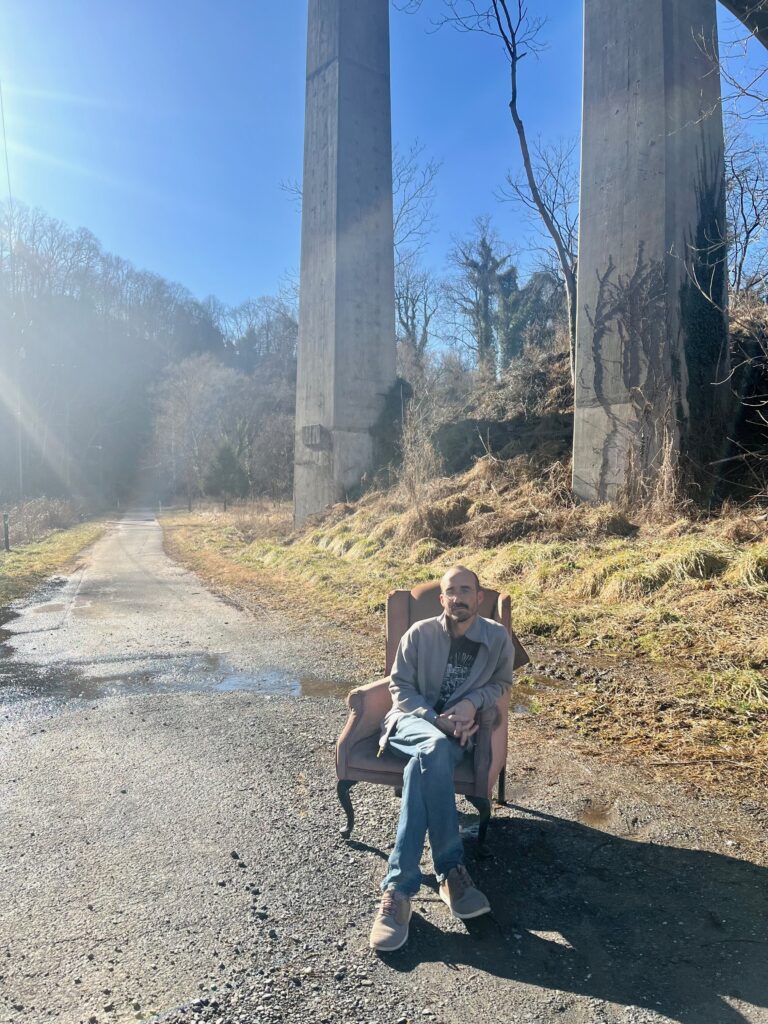
Matt Smith’s ancestors were in Jamesland as early as 1611, and were among the early English settlers of what are now Hampton and Norfolk, as well as on Jamestown Island, along the Chickahominy River, and in Surry County. He has made his home on seven different pieces of land within this basin, from dormitories in Williamsburg (College Creek watershed) to a cohousing community in Albemarle County (Mechums/Rivanna watershed) to his current home near downtown Lynchburg, where he can watch the James itself roll by from his front porch. A writer, web developer, and former environmental scientist with a graduate degree in geography, he has suffered from lifelong obsessions with history, maps, ecosystems, and the gift of rivers for weaving them all together. He currently puts these passions into practice through his work with the Cornell Lab of Ornithology and Piedmont Discovery Center.