
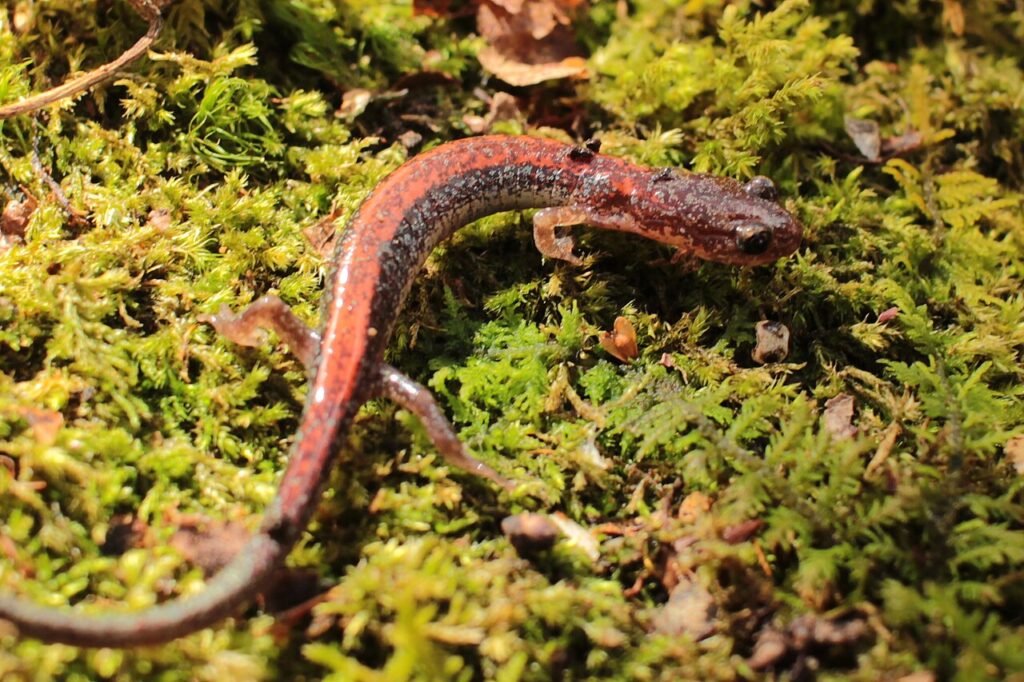
Central and southern Appalachia has long been touted as the salamander capital of the world. On maps showing global diversity of these amphibians and their relatives, this region pops out from all others in glaring red. Yet it’s only in recent years that the true scale of this phenomenon has begun to reveal itself. For starters, genetic analysis has exposed far more diversity than we had even imagined. Familiar and wide-ranging types like the red-backed salamander have turned out to be tangled complexes of cryptic sister species, many of them marooned on a few “sky islands” in the Blue Ridge and Alleghenies. With revelations like these the list of salamanders in Virginia has ballooned to near sixty—and counting.
The bulk of these belong to a tribe called the lungless salamanders (family Plethodontidae), as they’ve traded in their lungs and breathe entirely through their slimy, porous skin. Paradoxically, these creatures owe much of their success to the fact that they’ve abandoned the aquatic lifestyle followed (at least temporarily) by most of their amphibian kin. They lay eggs on land that hatch directly into miniature versions of adults, and spend their lives chasing bugs through the moist litter of the forest floor. It’s worked out well, judging by the sheer abundance of plethodontids on our landscape—something that has lately been measured in unprecedented detail. A 2024 study painstakingly counted red-backed salamanders in a number of spots across their range in the northeastern US, and got their highest estimate in a hardwood forest near Richmond, Virginia. The density works out to a mind-boggling figure of eighteen thousand salamanders in an area the size of a football field. Tote up the weight of all those tiny creatures and you end up with a biomass that dwarfs that of any other land vertebrate—deer, squirrels, mice, you name it. Around here, the red-back is the king of the forest.
What we thought was a red-back, however, turns out not always to be a red-back. In 2003, another secret species was added to the mix when the late herpetologist Richard Highton took a trip to the Big Levels. Sticking out like an elbow from the main line of the Blue Ridge, this three-thousand-foot plateau is underlain by sandstone and quartzite that give it a very different character from its neighboring mountains. It even boasts a highly unusual boggy wetland, Green Pond, at a gentle sag on its flat-topped summit (which is on the divide between the James and Potomac basins). Like most places in the area, it’s also crawling with red-backed salamanders—though a close look reveals subtle differences from that species’ standard model, including a larger head and longer legs. When Highton analyzed these oddballs’ DNA, he was able to confirm that they represent a distinct, reproductively isolated twig on the plethodontid tree. The new species was described as Plethodon sherando, the Big Levels salamander, and we now know that while it overlaps a bit with its red-backed cousin on the lower slopes of the Levels, the two seem to have worked out a system to avoid breeding with each other.
The Big Levels salamander is not the only plethodontid in Jamesland to have been discovered in modern times. The attractively speckled Cow Knob salamander, also described by Highton in 1971, is restricted to Shenandoah and Great North Mountains and a few neighboring peaks—extending into our region in a narrow stretch of Highland, Bath, and Augusta counties. Although efforts to secure protection for it under the Endangered Species Act have failed, this rare species achieved some notoriety in 2016 when it forced the Atlantic Coast Pipeline to be redirected from its planned route over Shenandoah Mountain. (The pipeline was later scrapped entirely.)

An earlier discovery was the Peaks of Otter salamander, another red-back relative with metallic-looking flecks on its back in place of the rusty stripe. Found solely along the high Blue Ridge between the Peaks of Otter and the James (thus straddling the James-Roanoke divide), this species was first described under somewhat scandalous circumstances. The first to take notice of it was a typewriter salesman and snail enthusiast named Leslie Hubricht, who sent specimens in 1949 to the herpetologist Gordon Thurow. Thurow mistakenly took them for a disjunct population of the Cheat Mountain salamander of West Virginia. But when the specimens were handled by two other herpetologists, including none other than Richard Highton (then still in his twenties), they suspected this wasn’t the whole story. The two relocated Hubricht’s original site (near the Black Rock Hill overlook), collected more of the odd salamanders, and drafted a manuscript describing them as a full species. They then made the mistake of giving a cordial heads-up to Gordon Thurow—who immediately drove up the Blue Ridge Parkway and grabbed some specimens for himself. At a dinner with Highton that evening, the crafty Thurow failed to mention his afternoon exploits, or that he was already plotting to steal his colleague’s thunder by rushing his own paper to publication.

The future is unclear for these sky-island specialties, as their already-tiny ranges stand to shrink even further with climate change. Down at the bottom end of Jamesland, a very different salamander is facing a different but no less real set of threats. The Mabee’s salamander belongs to the family Ambystomatidae, known as the “mole salamanders” for their burrowing habit as adults. This group includes some better-known species like the tiger and spotted salamanders, which are typically larger than the plethodontids and endowed with a working set of lungs. Unlike their lungless cousins, they lay their eggs in water and spend their larval stages in a fully aquatic, gilled form. This means that each year during the late winter or early spring, they must make a treacherous overland journey to return to the small, ephemeral woodland ponds they favor for breeding.
One of the rarer and less-studied members of its family, the Mabee’s salamander was long thought to be limited to the coastal plain of the Carolinas. It wasn’t until 1979 that the species was found north of the border in Virginia. Although it’s now documented from a handful of spots in the tidewater region of the state, by far the most robust population occurs in an area known as the Grafton Ponds, along the border between York County and the city of Newport News. This is a remarkable set of around two hundred small sinkhole depressions, formed by slow dissolution of the shell-rich sediments underneath, which fill seasonally with rainwater and transform into salamander paradise.