
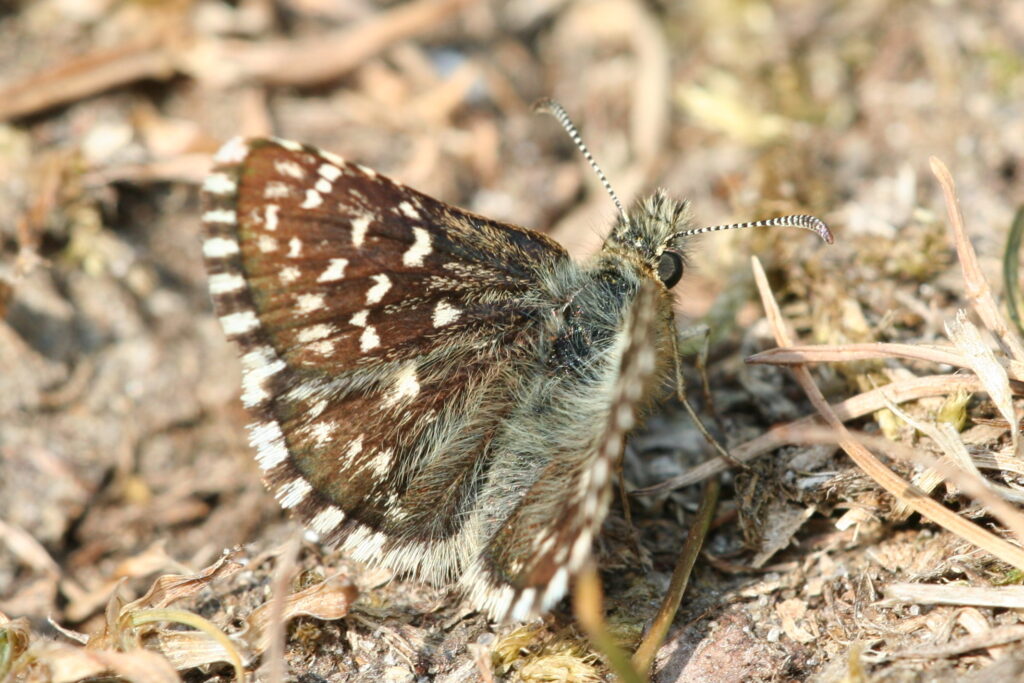
Grizzled skippers are survivors. Despite maxing out at barely an inch across, these delicately frosted butterflies thrive on the Alaskan tundra and above the Swiss Alps treeline. It’s ironic, then, that one of their southernmost representatives—the Appalachian subspecies of the northern grizzled skipper—finds itself in the greatest peril.
P. c. wyandot (which some scientists maintain should be treated as its own full species) once lived along much of its namesake mountain range from New York to North Carolina, with satellite populations in Ohio and Michigan. Although its only strict requirement is the presence of its host plants—with its caterpillars showing a special preference for the yellow wildflower dwarf cinquefoil—in practice this butterfly does best in a very specific habitat. That’s the shale barren, which occurs as small patches of outcropping rock on slopes of the Ridge and Valley province. These barrens are strange and grueling environments for plants, as they are typically steep, offer little soil to cling to, and can reach Sahara-level temperatures as the dark shale absorbs the summer sun. Not surprisingly, the plants (and therefore the animals) that do manage a living there make for a very eccentric bunch.
Not quite as picky as some of its neighbors, the skipper managed to maintain a relatively wide range for untold centuries. Then came catastrophe in the form of the spongy moth (formerly known as gypsy moth), a Eurasian species introduced in the nineteenth century as part of a misguided silk venture. Its voracious caterpillars quickly made a name for their species as one of the worst non-native offenders, and it has not slacked off since, defoliating tens of millions of acres and wreaking nearly $1 billion in damages annually. Yet the effort to control the moth’s spread has been massively destructive in its own right. Indiscriminate spraying of pesticides took a huge toll on native butterflies and moths, with some proving more vulnerable than others. The grizzled skippers, with their little caterpillars out in the open amidst vast tracts of spongy moth territory, succumbed quickly. The first burst of spraying was enough to wipe them out from the northern end of their range by about 1960; another burst in the late eighties, focused on the central Appalachians, took care of most of the rest. To add insult to injury, human suppression of the natural fire that once helped to maintain the butterflies’ forest clearings has eliminated many of their historic sites.
But the skipper’s story was not over. In 1992 a few individuals were found fluttering around a Virginia shale barren called Brattons Run (in Rockbridge County), giving conservationists some hope. More turned up over the next few years at a few spots in neighboring Alleghany County, including the state’s Potts Creek and Johnsons Creek Natural Area Preserves. Today, the barrens of the upper James basin are the undisputed stronghold of this beleaguered butterfly. Populations elsewhere are either extirpated, dwindling dangerously, or (in the case of Michigan) perhaps not Appalachian skippers at all.

Water-boatmen are not creatures that attract much attention. Usually no more than half an inch long, these aquatic members of the true bug tribe live their lives peacefully: paddling around in ponds and stream backwaters with their oarlike hind legs, munching on algae. They have ways of attracting each other, of course—even producing cricketlike “songs” by scraping their legs against their heads. But most humans live in ignorance of these unobtrusive insects.
Not so with entomologist Marvin Bobb, who spent years collecting and documenting all the water-boatmen of Virginia. This is the work of a true obsessive. There are some five hundred members of the water-boatman family (Corixidae) worldwide, and most are only distinguishable by close examination of parts like the claspers (tiny appendages used by the male for holding his partner in place). Yet in the summer of 1947 when Bobb lifted his dip net from a creek in Fluvanna County, he knew right away that he had something unusual. This water-boatman had a striking pattern, with a dapper set of stripes outlining its dark wing panels. It resembled another species found mostly south of Virginia, but it wasn’t a perfect match.
The Fluvanna bug was formally described the following year as a new species: Sigara depressa, the Virginia Piedmont water-boatman. Efforts over the next couple of decades turned up a few other tiny, isolated populations, in Prince William, Caroline, and Hanover counties. But then thirty years went by without any trace of the species. Even Bobb’s original site, which had boasted dozens of individuals that first summer, had yielded only a few the next year and seemingly none thereafter. Had science stumbled upon the enigmatic S. depressa right as it was becoming extinct?
When Virginia’s Natural Heritage program launched a comprehensive resurvey for the species in 1997, that at first seemed to be the demoralizing conclusion. Of the streams from which it had been collected earlier, one had disappeared from maps and been obliterated by a subdivision, while another had been hopelessly transformed by the creation of the giant reservoir Lake Anna just upstream. But then the team tracked down Marvin Bobb’s very first site, a quiet pool along Ballinger Creek south of Zion Crossroads. On a November evening they hit paydirt at last, netting five specimens of the bold-striped swimmers that had escaped detection for three decades. They spent the next day scouring that stretch of the creek for more water-boatmen, and came up empty. For now, that is how the status of S. depressa remains: its entire known population, if it exists, confined to one spot in the James River basin. The region’s most mysterious insect won’t be giving up all its secrets just yet.

Beneath the surface of the Ridge and Valley region of Jamesland is a hidden labyrinth of sinkholes, caves, and sunken streams (a landscape called karst), formed over millions of years by groundwater percolating through the soluble limestone bedrock. This upside-down world has become a hotspot of biodiversity as various types of organisms have wandered underground, adapted over time to the alien conditions, and become isolated from their former kin. Cave beetles are just one example of this phenomenon: evolved from more conventional forms of ground beetle in the family Carabidae, they now constitute their own troglodyte tribe characterized by a lack of eyes, wings, and pigment. These insects stick close to water, feeding on aquatic worms and often hiding beneath rocks.
As many as 250 species of cave beetle may occur across the karst region of the eastern United States, many of these restricted to a single cave. Jamesland hosts at least three of these that occur nowhere else:
– the Crossroads cave beetle, endemic to Crossroads Cave and Williams Cave in Bath County
– the Nelson’s cave beetle, endemic to Arritt Mill Tunnel Cave and Blue Springs Cave in Alleghany County
– the Natural Bridge cave beetle, endemic to Natural Bridge Caverns in Rockbridge County
…with other likely endemics still awaiting full description from Starr Chapel Cave, Showalter Cave, and Burnsville Cove. In many cases like these, development of the surrounding area (causing increased sediment and pollution in the groundwater) and human incursions into the caves have placed their denizens under threat. Human impacts have been especially severe at Natural Bridge, where the caverns have been developed into a tourist attraction. The Natural Bridge cave beetle was last seen in 1992 and may well be extinct.
The elusive Appalachian grasshopper (Appalachia hebardi) was long thought to be extinct, having been spotted once in 1946 and then unrecorded for decades. It then made headlines by turning up on the side of a road in Augusta County, Virginia in 2024. Since then a modern army of citizen scientists armed with tools like iNaturalist has taken aim at the resurrected species, and it’s now been documented in several spots, including a few in Jamesland’s highlands as well as in West Virginia and Pennsylvania.
The Dismal Swamp green stink bug is another enigmatic insect that is known from only a handful of records, and was originally thought to be restricted entirely to the Great Dismal Swamp. New data extends its range a bit further afield, but as it seems to be dependent on rare canebrake habitat, its population is likely small.