
Marybird lived just up from my place, though you could never get there now. The twelve miles start to feel like a hundred, the longer you look at the map; they wrap you around the mountains, Bucks Elbow and Pasture Fence and Pigeon Top, over creeks named for men older than America, past hollows named for wildcats and peavines and maple sugar, and deliver you right up into the greenstone arms of the Blue Ridge. As for the sixty years that separate us, they might as well be a thousand.
She was the fifth of nine—Tex, Jane, Reuben, Early, Lucie, Idy, Walker, Grant—and outlived them all, save Early who went off to Illinois. She had eight of her own and outlived six of them, too. By the time Marybird was done, and the timber had been cut and the wildest things had been run off, she was just about the oldest thing left on the mountain, aside from the rock.
Like the mountains, Marybird was a study in soft and hard. The Appalachians draw you in, with their blue haze and leafy carpet, only to bust your knees on their crags, trip you up on the coils of old copper stills or timber rattlers. They’d been as high as the Himalaya once, and had worn down for a couple hundred million years till there was nothing left. Then a shrug of the earth had lifted them right back up—not as high as before, but high enough to be proud. All that rising and settling had smoothed out the soft stuff and left some hard parts sticking out, like the granite up on Old Rag and the lava rock boulders up the hollow from Marybird’s. And she had that look too, with a big, stubborn nose and brow that jutted from her gaunt face like promontories.
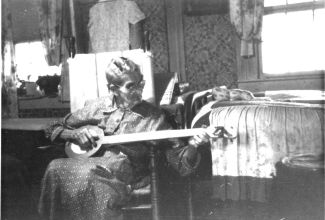
Marybird had been hardened in the usual way, for that part of the world. “I seen a lot of trouble,” was how she’d sum it up. She’d never gone to school—“I’d a-learnt, too, if I’d a-went”—and instead had married at fourteen, to a skinny young man called Lem from over the mountain. Against the wishes of Lem’s folks, Marybird’s dad Turkey had taken them up to get married in Hagerstown, which might as well have been Calcutta. Turkey had been in the war and spoke often, at night, of the men who’d fallen around him “like flies.” In Hagerstown he’d left Marybird in a hotel by herself and ventured out to lose himself in liquor. The lady who ran the hotel sat up into the night sewing and talking with the frightened girl. Marybird fixated on that act of kindness later in her life, as though it haunted her.
After she’d had her babies Lem started to wander. He ran away with another woman off to West Virginia, where she bore him a child and died. Then he came back and took up with another woman, who’d wait for him every night on the hill above Marybird’s house. Lem would go out to shut up the chickens, and he wouldn’t come back. Marybird lived for her kids, but they didn’t last, either. Hester, the oldest, moved away with Wilmer Morris, who “wasn’t no good,” and died in childbirth; later Wilmer came and took the baby from Marybird, and it died too. Frank, the sixth child, went dove hunting and accidentally shot himself. Jake was the last and she doted on him most of all, nursing him till school age and weeping when he quit. (“I never would be satisfied no more in my life,” she said.) He died drunk and Marybird missed his funeral: nobody had the heart to tell her.
Such was the upheaval and erosion that shaped Marybird, as it shaped so many of her people. She would have lived and died like them, too, reduced quietly to dust in this place at the ends of the earth, if it hadn’t been for the banjo.
She’d discovered it at the age of ten, sneaking a pick on her brother’s when he was out. Before long she’d fashioned her own, out of an old wooden hoop, a piece of cardboard, and a few strings of waxed cotton. As the years went on there would be better instruments, made from squirrel skin in the proper mountain way, but the music would never abandon her. And in the final chapter of her life, it was the music that would at last find her a good man: a blue-eyed, soft-faced young singer from away up North, who followed its call up into Brown’s Cove and saved Marybird for the world.
In the spring of 1931, a baby called Paul Worthington arrived in a world that was disintegrating all around him. The Depression was reaching its nadir and the national headlines were dire. In the Worthingtons’ town of New Bedford, Mass., the brick cotton mills that lined the Acushnet River like battlements—mills that employed four of five New Bedfordites—were going belly up, twenty-eight of them in a five-year span. And at the heart of this concentric chaos, the Worthington family itself was crumbling too.
Paul’s father Clayton was a wandering salesman, the son of a wandering painter, both of them only capable of love in fits and starts. His mother, Adah, was the daughter of a man who’d outfitted whaling ships for a living; she had something of the sea in her, deep and tempestuous. They’d already moved in with her parents as money got tight, and with the stress of raising a child their fights began to escalate. When Paul turned four they finally split, in spectacular fashion: at a family picnic, Clayton announcing out of the blue that he wanted out, Adah chasing him furiously around Buttonwood Park in her car, as he darted behind trees to escape.

Paul saw it all. Sensitive and searching from day one, he set himself to finding something simple and true, something beyond the cycle of violence and decorum and despair in which his world seemed to be stuck. It was the sea that gave him the first glimpse of such a thing. At his grandfather’s knee he learned of New Bedford’s days of glory, when its mighty fleet of whaling ships had circled the globe from the Arctic to the South Seas, returning with an overflowing bounty—tens of thousands of gallons of oil on a single ship, and tens of thousands of pounds of baleen—that vaulted the town improbably to the title of richest on Earth. He gained an abiding distrust of the newly globalized, corporatized system that had abandoned the whalers for petroleum and cheap foreign labor, and thereby brought New Bedford to its knees. And most importantly, he heard the songs.
The whaling ships had been as full of music as they were of blubber. This wasn’t the stuff of the preening crooners that Paul heard in the parlors of Summer Street. This was to that what raw ambergris, blotched and reeking from the sperm whale’s gut, was to the perfumes into which it was distilled. The sea-shanties and sea-ballads were sloppy, vulgar, laced with ship jargon and haunting pathos and archaic turns of phrase, and seemed to have sprouted organically from some kind of primeval, overripe earth. Grandfather Hardy knew the popular ones, tunes like “Spanish Ladies” (Farewell and adieu to you, Spanish ladies / We’ll rant and we’ll roar across the salt seas) and “Blow the Man Down” (Come all ye young fellows that follows the sea / To me, way hey, blow the man down). By eleven Paul had gotten his hands on a guitar and was picking some of these tunes out. By a few years later, he had discovered that these were merely the tip of the iceberg.
Given a curiosity as relentless as Paul’s, it was only a matter of time before he found his way into the recesses of New Bedford’s whaling museum. This was a great stern building up on Johnny Cake Hill, whose cupola loomed over the harbor like the church of a forgotten religion. Among its treasures was a painstaking half-scale reconstruction of the bark Lagoda, at the time the largest model ship in existence. But far more interesting to the budding folklorist were the shelves full of moldering paper kept in back.
These were ship’s logs, and for an imaginative soul they offered a secret wormhole into a lost world. Buried amongst the mundane reports on the weather and the crew’s duties, Paul found a motley assortment of treasures, like a whaler’s lament on being captured by Confederates in 1862:
Here we are on the beach flat on our behind without a cent & my shoes all burst out & no signs of getting any more with a devil of a commotion…like Roberson Cruso of old almost. No way to get of as I see. Our ship in sight burning.
To his delight, the logs were also brimming with song lyrics: capstan shanties, short-haul shanties, halyard shanties, patriotic broadside songs, proto-punk anthems of protest and insult, and ballads full of longing for lost shipmates and girls ashore. Some seemed like the untraceable echoes of bygone ages:
In Amsterdam there lived a maid,
Mark well what I do say.
In Amsterdam there lived a maid,
Who was always pinchin’ the sailor’s trade.
I’ll go no more a roving with you fair maid.
Others excited him with their coarseness, or amused him with their childish inanity:
Oh we’re rollin’ down to Trinidad to see Miss Sally Brown
Roll boys, roll boys roll…
She’s lovely up aloft, an’ she’s lovely down below
Roll boys, roll boys roll!
Cape Cod girls, they have no combs,
Heave away, heave away;
They comb their hair with codfish bones,
We are bound for Australia.
…while yet others arrested him with their depth of feeling:
My Captain brave shall read for me
The service of the silent dead,
And, yea, shall lower me in the waves
While all the prayers are said.
And I shall find my long way home
Among the billows and the foam.
After a few sessions in the museum stacks, Paul found himself inflamed with evangelism. These discoveries of his, these pearls plucked from the seabed, as it were, had to be shared with a public whose eyes had been long crusted over by civilization. By the time he turned sixteen he had landed a regular 15-minute slot on a local radio station, soon to be expanded to an hour, during which he introduced and performed some of the whaling tunes and other traditional songs he’d gleaned from his voracious collecting.
On graduating from high school, his driving motivation was to find new hunting grounds, places where authentic expression still persisted and music still sprang from the soil. The motivation was not purely academic. The urge to express himself authentically—a self whose dark, alien depths he was only beginning to plumb—had become a smoldering fire that a repressed New England town could no longer contain.
Of the many tales that were told in Brown’s Cove, here are three of the most cherished and repeated.
Once, in slavery time, there lived in the Cove a magic man called Jim Royal. He was a little black man who rode a little white horse, and carried with him a bag of black spells brought from Africa. He carried a fiddle, too, and the fiddle had powerful magic. Jim could break it into a hundred pieces and it would put itself together; or he could sit and play on top of a burning brush pile, without one hair getting singed. If he got in trouble he’d vanish, and the next thing you knew he’d be sitting on a stump a hundred yards away, just laughing and fiddling. Or he’d hop on his little white horse, and with a cry of “Up we jump and here we go!” he’d go sailing off, hooves never touching the ground.
There was another man called Linkus Shiflett, a white man, who’d made his own fiddle out of a gourd, and he told Jim Royal he wanted to learn to play like Jim. “If you want to go through the ordeal that it will require,” said Jim, “then I will teach you.” And he gave to Linkus a dozen tasks, each one harder and stranger than the last. For the first, he simply had to cut nine holes in an ironwood tree, and run his bow through the holes nine times each, each morning for nine days. But for his final task, Jim Royal pointed him to an old outhouse way out in the woods, and told Linkus he must sit in there all day without saying a word. Linkus went in and was subjected to torments more terrible than you can imagine. At day’s end a great black snake came in, wrapped itself around his neck, and put its head through his mouth and all the way back to his throat. When Linkus came out he could fiddle like an angel. And if you ever had the nerve to try to play alongside him, your strings would mysteriously up and break before you could finish a verse.
Not so long ago, and just over the mountain, there lived a giant of a man called George Herring; his grandchildren still live hereabouts. Everyone knew that George had the black magic, and the way he came by it was this. As a young man he had a neighbor named Old Solomon, a black man with a reputation as a witch. It came to pass one day that when George called his cattle in from pasture, they dropped dead right there in his barnyard, one after the other. He went out to investigate and found, on the cow paths between his place and Old Solomon’s, strange markings in chalk. He knew then and there that the old witch had him under a curse, and he set himself to fighting fire with fire. Off he went for many days, and when he returned he had powers to rival Old Solomon’s. And he had a plan.
That night he told his family to go to bed and not to set foot downstairs. He built a fire and drew some special signs on the floor around it, and he sat up all night watching the fire. At last there came a great commotion in the chimney, and out from the fire sprang a black cat. George jumped up and kicked that cat back into the fire and it vanished.
The next morning, a black girl appeared at the door. She said that her daddy had been burned and was barely living. Three times she came back, asking to borrow a different thing, and three times she was refused. George had told his family not to lend her a single thing, knowing that this was the only way to finish off a witch. And by day’s end Old Solomon was no more.
At the time of the Civil War, there were many folks in the Cove who wanted nothing to do with it. They disapproved of slavery, or had friends on the Union side, or they just wanted to be left alone. All three of these were true of Tom Frazier. He reluctantly volunteered for duty on the assurance that there would be no bloodshed, and when that proved false, he left the army and went home to the Blue Ridge. The Confederacy decided to make an example of the deserter, and sent a guard force into the mountains to track him down. So began Tom Frazier’s three-year fight for survival.
Each time his pursuers had him in their grasp, Tom found a way to get free. Once, on the mountain, he was shot and left for dead in a pool of blood, only to find that the bullets had grazed his skull. Once, near Gordonsville, he slipped from his shackles and dived out of a train window. Once, in Petersburg, he cut through a prison wall with a knife and swam handcuffed across the Appomattox River. He made it home each time, and dug his own sham grave there to fool the searchers into abandoning their hunt. But it was to no avail.
In the spring of 1865, Tom Frazier was caught once more and the sentence this time was death. He and two other deserters were sent to Staunton to be hanged. Along the way the party stopped at a farmhouse for a meal, and the guards got into some liquor. According to some versions of the tale, one of the other convicts was none other than Linkus Shiflett, and he played his fiddle so sweetly for the guards that they set down their weapons in a trance. Tom decided that it was now or never. Giving his companions a wink, he took off running across the field, weaving to dodge the bullets. When he reached the rail fence at the edge of the woods, he dived clean over just as a bullet split the top rail. And that was the last the Confederacy saw of Tom Frazier.
As some folks tell it, he got away by leaping onto a little black mare. That horse sent her hooves flying until the guards scattered all around her. Then she took off, and the next thing you knew she was soaring, just like a bird.
Marybird’s people, it could be said, were the original mountain folk.
The first settlers crossed the Blue Ridge in the 1730s, just a few miles down its spine from Brown’s Cove. Michael Woods was an Ulster Scot and devout Presbyterian who brought his wife, five sons, five daughters, three nephews, and a niece across the ocean, down the Shenandoah Valley and over a nameless gap into the wilderness. At a spot they called Mountain Plains, Mary Woods at last planted the white rose cutting that she had carried with her all the way from Edinburgh. It was still growing some two hundred years later.
Can we even fathom the thirst for liberty that drove these people into and over these mountains? It helps to know that in the time of the Woods’ parents’ generation, Presbyterians in the Old Country were being tortured with thumbscrews and staked onto mudflats to be drowned by the tide. But the trials that awaited them on the Virginia frontier were staggering. Nights were punctuated by the howling of wolves and the screaming of panthers. Smallpox was a constant, implacable threat; thirty years later, even Thomas Jefferson would have to travel as far as Philadelphia to undergo inoculation against the disease. Such was the isolation that the Woods children had to journey sixty miles through trackless woods just to get married. This was only legal if performed by the Church of England, of course, but it was a thing that must be done.
Most dangerous of all were the real original mountain folk. The Shenandoah was not only a conduit for German and Scotch-Irish settlers, but also a warpath for Iroquois parties raiding the Siouan and Algonquian peoples to the south. Like the settlers, these groups were taking advantage of a fleeting vacuum; the Valley’s native inhabitants had long since vanished, leaving behind only potsherds and postholes from their palisaded villages. Now the Iroquois were building a great confederacy, with its border set uneasily at the Blue Ridge, in the hopes of stemming the great white tide.
Around Christmas of 1742, one of their war parties pitched camp near a house belonging to the extended Woods family, and a series of misunderstandings sparked a melee in which Mary Woods and her son-in-law were both killed. (Maybe, in Mary’s case. The facts of the event are inscrutable now, muddied by conflicting settler and Indian accounts and varnished by frontier romanticism.) The event produced yet another treaty between the tribal leaders and colonial governors, which the former understood to entail selling the Shenandoah for cash, and the latter would ultimately interpret as cementing Virginia’s claim to everything this side of the Pacific.
The treaties hardly mattered, for the tide kept rising. The Conestoga wagons streamed down the old Indian path, now rebranded as the Great Wagon Road, and ever deeper beyond the official line of authorized settlement. Indigenous resistance became increasingly desperate. In the lands between the Shenandoah and the Ohio, a crossfire of Shawnee and Iroquois raids and white “Indian hunts” culminated in brutal massacres in both directions. Men were scalped; women were abducted; an Iroquois infant was impaled on a spike. These visions would live long in the collective imagination.
Through it all the Woods clan persevered and multiplied. Another Christmas, in 1767, was galvanized by the sudden appearance of a girl disguised as a British redcoat. To everyone’s shock, it was Magdalena Woods—Michael’s seventeen-year-old granddaughter—who’d been kidnapped by the Shawnee during a massacre three years prior and given up for dead. Her story was harrowing. She’d hidden behind a pile of corn that day and watched the slaughter, and had then been hauled off across the Ohio River and given to the chief as a special prize. Soldiers from a nearby fort had discovered her and staged an elaborate rescue, but this had only delivered her into the hands of a cruel British general who’d taken as many liberties with her as the Shawnee. After a year of this—“always wishing for death”—she’d been rescued again, by kind-hearted officers who’d helped her cut her hair, stain her skin, and steal a uniform and a horse, in order to steal away from the fort and complete her epic journey home.
(Maybe. Like so many frontier tales, this one is corroborated only by family tradition.)
Such was the price of freedom. But by the mid-18th century that freedom was already eroding, as both the settlers and the Indians found themselves to be pawns in an inconceivably huge geopolitical game. Hungry for territory, the British colonial government had begun incentivizing frontier settlement—first by issuing huge grants to (often absentee) speculators, later by offering tracts of virgin land in return for military service. Meanwhile, outnumbered and beleaguered, the French set about enlisting Indian help to push back against British encroachment. The Shawnees who targeted settlements in the Shenandoah were acting not from impulsive blood-thirst, but as part of a deliberate series of maneuvers across the colonial front, eagerly abetted by Paris.
It was worse than that, for as the generations rolled on, the ghoulish fingers of a new kind of system began working their way into every hollow and around every knob across Appalachia. This was a system that would not be satisfied with mere acquisition, only with complete domestication and abstraction and control. To its eyes the haphazard wilderness in America’s backyard was an unignorable affront, a literal uprising of raw earth, needing to be flattened, digested, rendered intelligible to the skeletal logic of capitalism.
Sometimes, in practice, this meant a land company buying thousands of acres of “vacant” land—land formerly used as a great green commons, for the seasonal rhythms of gathering ginseng and sassafras, tanbark and sugar, chestnuts and huckleberries, ramps and poke—and pillaging it outright, the faster the better, to stay ahead of the half-hearted march of corporate accountability. Sometimes it meant razing the mountains’ timber and sucking dry their mineral innards, while leaving to the landowner a compensatory pittance along with “surface rights.” These turned out to be as paper-thin as the wasted landscape, more often than not, as the exploiters deployed a bag of bureaucratic tricks to further loosen the hold of the locals. The infamous broadform deed, for instance, gave to mining companies the right to extract minerals by any way “necessary or convenient”: a catastrophically open-ended promise, as the next generation of mining technology turned out to involve bulldozers and dynamite.
The logic that demanded the consumption of the land, the conversion of forest and rock to lumber and fuel, also demanded its disenchantment. All things threatening, all things uncanny, anything or anyone with a prior spiritual claim, needed to be eliminated. Only this can ultimately explain the mechanical efficiency, and the maniacal persistence, with which the indigenous protagonists of Appalachia were driven to extinction.
If the everyday insecurities of the mountain folk provided the raw fuel for this process, in all cases it was the intervention of distant government or the influence of the free market that brought it to its consummation. Thus the clamoring of the settlers for protection against the Indians was distilled into giant new lines on the map, lines that kept receding into the frontier as the fledgling colonies learned to test their boundaries. A conference with the Iroquois in 1722 had established the Blue Ridge, verbally at least, as the border of the Virginia Colony. When the Indians later complained that whites were still arriving, “like flocks of birds,” into the Shenandoah Valley to the ridge’s west, they were offered a reinterpretation of the old treaty. In its written form, it had prohibited the Iroquois from trespassing on British land, but had given no formal assurance of the reverse. Moreover, the “great Ridge of Mountains” mentioned in the treaty was ambiguous, wasn’t it? When a new treaty was drawn up to resolve the confusion, that “great Ridge” turned out not to be the Blue Ridge at all, but the Alleghenies thirty miles to the west.
Among the wild things found on the frontier, there were four that proved no less objectionable than the Indians in their occupancy of physical and spiritual space. These included colonial America’s two largest creatures and its two fiercest predators, and each met its end in an eerily similar fashion: driven from the flatlands and tracked down to a final stronghold in the Appalachian “outback,” all within a three-county area in the rugged heart of West Virginia, less than a hundred miles west from Brown’s Cove.
The bison were first to go. The massive beasts had once roamed as far east as the grassy woodlands of the Piedmont, supplying Indians and early settlers with occasional meat, and lending their name to countless “Buffalo Creeks” and “Buffalo Gaps” that still anachronistically litter the map. They had retreated before the advancing frontier, shying from the guns but also from the closing forest, as the controlled fires of the Indians vanished from the landscape. But it was the lure of money, and not the drive of hunger, that extinguished them from the East for good. New markets opened up in the late eighteenth century, and a new, mercenary breed of hunter arose to meet the demands. Tracking the dwindling herds for hundreds of miles across the backcountry, they sent boatloads of beef, tallow, and tongue downriver to merchants in Louisville and New Orleans and the West Indies. For some years, having vanished from the lowlands, the animals would still emerge in small numbers from their Allegheny redoubts to gather at the natural salt licks in the Kanawha Valley. By 1825, the number was just two: a cow and her calf. The calf was shot at the lick; its mother escaped, and had to be tracked through miles of wild land to be brought down at last.
The others followed a similar pattern, though they lasted longer. The final Appalachian elk was shot in 1875, with brutal irony, at the headwaters of the Elk River. The last cougar was hunted down in 1887, on the slopes of the very highest peak in the Alleghenies, by a local sportsman recruited by a one-armed law clerk from Washington. (It fought on even when full of buckshot, mauling the dogs that had treed it, until the men finished it off with their bare hands.) But it was with the wolf, that archetype of feral darkness, that the colonists had their longest and most fraught engagement.
From the beginning, wolves had been cast as murderous thieves in the night—“Evening Wolves,” in the words of Cotton Mather, “the rabid and howling Wolves of the Wilderness, [that] would make…Havock among you, and not leave your Bones till the morning.” In reality, not only were they almost never a direct danger to humans, but their crimes consisted less in entering human spaces and more in taking that which had been thrust into their own. The woods of the colonies were soon teeming with hogs and goats and sheep that their owners had no practical means of enclosing. Wolves wasted little time in appreciating the new bounty, and the settlers responded with fear and cruelty that sometimes far outstripped the actual threats. Villages took to flaunting severed wolf heads on their public buildings, each one serving as a comforting proof of justice, but also as a desperate talisman against the howling wilderness. The creature’s role as all-purpose phantom and scapegoat and nemesis took on forms both mysterious and banal, as colonists “cried wolf” throughout the East; more than one preacher observed that attacks on sheep seemed to spike just before Sunday services.
The first wolf bounty in Virginia was offered as early as 1632, and wherever money was introduced into the equation, the wolf war took on a new intensity. Bounty hunters devised a series of weapons of escalating barbarity, from pits lined with sharpened sticks, to chunks of bait studded with mackerel hooks, to carcasses laced with strychnine. Indians were recruited to help track down the beasts, sometimes in return for corn or furs or tobacco, sometimes as a mandatory tribute, with whippings as punishment for non-compliance. Cheating of the system quickly became rampant: dog or fox ears would be passed off as proof of a kill, or wolf heads would disappear from one town hall at night and be submitted at the next in the morning. By the turn of the nineteenth century, the species had been exterminated from most of the East, and feral dogs—as well as their hybrid progeny—were the far greater threat to livestock. But still the bounties continued, as reports of depredations continued from remote areas like the Alleghenies.
As of January 1, 1897, the best I can reconstruct it, the wolf population in the original thirteen colonies was down to exactly one. This was a wily old male in the high Alleghenies of West Virginia, whose pack had been slaughtered five years prior and who had managed to elude all hunters since. After the fugitive allegedly killed twenty-seven lambs up on Point Mountain, a handsome bounty of $100 was placed on his head. On that New Year’s morning, another farmer came forward to report the loss of five good sheep. Despite the subzero temperatures and the fresh two-foot snowfall on the ground, a makeshift posse was rounded up and the hunt was on.
And on it went, for eight days and across four counties. One morning a member of the party got a clean sight at the wolf, at fifty yards, and his gun inexplicably failed to go off. The rumor spread that “the hand of the Almighty” was against them. But at last the animal was brought down, by a seventeen-year-old boy, at a distance of one hundred and eighty-seven paces. The fabled beast turned out to be little more than skin and bones, having found nothing more than a grouse to eat during the chase.
So passed the Eastern wolf. Its stigma would take longer to fade, though even that had become less carnal and more spiritual, as the creature had retreated into abstraction. The “fierce, bloodsucking persecutor” that had been bemoaned by Roger Williams was now, in the words of Teddy Roosevelt, a “beast of waste and desolation.” An emblem, in other words, of the waste-land, the shrinking realm of what could not be used, and must be discarded.
Just over the mountain from Marybird’s, during her parents’ time, a lawyer named John A. Alexander bought up some twenty thousand acres of more-or-less virgin forest. It took him fourteen years to chew through most of the timber, which was reduced to charcoal to feed an iron blast furnace (a process that devoured an acre of forest a day, or more). What remained on the upper slopes, the steepest, rockiest stands, were doggedly hauled out over the next two decades and stripped of their bark for tanning leather. By the time the tract changed hands, now completely denuded and charred to the rock by brush fires, it was appraised at well under two dollars an acre. The owner himself, by then serving time for forgery, was in no position to argue.
In this way the old-growth forest of Appalachia, the work of centuries, was virtually annihilated in the span of a generation. Although it would grow back in patches as the industrialists moved on, the abuse of the land was an impossible stain to remove. The crippled ecosystems would be visited by plague after plague, like the chestnut blight, an Asian fungus that was accidentally imported at the turn of the twentieth century. Within forty years it had swept across the continent and surgically removed the American chestnut, perhaps the Appalachian forest’s defining species, from the entire region. Though it felled some four billion trees, in a baleful twist the disease did not kill the plants off entirely: it left the shoots to go on valiantly sprouting and withering from the stump. But the sweet, spiny nuts of which Marybird as a girl had gathered so many thousands, and the light, lasting wood from which her people had fashioned so many cabin beams and fence rails, would be seen no longer.
With the blight, the long, subtle theft of Appalachia had reached a sort of apotheosis. Distant networks of global exchange delivered an invisible killer, one that leveled the proudest creations of the forest and left it in a state of perpetual immaturity. A very different face of this leveling process would be presented, later in the twentieth century, by the extremely visible, almost absurdly crude methods of the coal industry. These would entail a literal erasure of the landscape, the removal of entire mountaintops and the burial of hollows much like Brown’s Cove in processed rubble. The human communities in their path would be leveled no less than the land, whole towns employed and abandoned in waves, left with broken backs and opioid addictions and crushing despair.
There were no coal seams in the northern Blue Ridge; the mountaintops are still here. But the economic obsolescence of this region, the first to be claimed, exploited, and forsaken, left it vulnerable to a very different form of appropriation. When the National Park Service started planning a grand eastern park, a new Yosemite to serve as a “playground” for city folk along the Atlantic seaboard, this ribbon of mountains in Washington’s backyard was the obvious target. The only trouble was that the prevailing view of “nature”—as a purified, aestheticized space walled off from human impact—left no room for the four hundred and sixty-five families, Marybird’s cousins among them, that happened to inhabit the land.
Most of these were subsistence farmers whose meager sources of supplemental income were already strained or exhausted. Historic droughts had decimated the apple and peach harvests. Factory-made goods had eaten into the markets for local crafts. With Prohibition in full swing, making moonshine was a risky business. And the chestnuts that had once been gathered and sold were a thing of the past. These changes were bewildering enough; then came, without warning, the invasion of black-coated bureaucrats brandishing terms like eminent domain.
If the locals were ill prepared for these, they were still less prepared for the sociologists, who arrived from places like Chicago to lend an academic veneer to the marginalization of the mountain communities. In a work mischievously titled Hollow Folk, one such scholar painted a bleak picture of an “unlettered” culture that was “not of the 20th century,” with “no community government…no organized religion…and only traces of organized industry.” In their “tiny, mud-plastered log cabins,” it seemed, these unfortunates lived in a state of near-savagery, amidst “hosts of flies, fresh from their feasts on human excrement”; so deprived were they that “a penny was received as gratefully as a half dollar,” and so primitive that “nobody is tortured with a gnawing conscience” and “‘love’…calls for little more than physical gratification.” Marybird might have been especially startled to read that in these hollows, “children do not frolic [and] elders do not talk freely. There is little visiting from one cabin to another. There are no family reunions or holidays.”
Works like these served as a stamp of validation, easing the collective guilt and clearing the way for what would soon become Shenandoah National Park. The decade leading up to its establishment was a litany of broken promises, abandoned policies, meaningless “consultations,” and legal loopholes that ended with an all too predictable result. Only sixty souls were permitted to keep their homes inside the park, and less than half the rest were financially compensated, most with a farcically small amount. Of those that were “resettled,” by twenty years later all had moved on. That kind of life, with mortgages and water bills and neat rows of Cape Cod houses, was not theirs.
Today, the road up the cove from Marybird’s place—a road her ancestors hacked from the wilderness, whose weary travelers they housed and fed for generations—is blocked by a gate. Past that it still straggles on upslope, its fading switchbacks now sliced by a powerline cut and shaded by the gathering second-growth, till it’s cut off at last by Skyline Drive and its constant stream of tourists: cruising at thirty-five by the thousands, along the crest that once marked the edge of the known world.
In the year 1949, there was no more compelling place for a folklorist to be than the southern Appalachians. Here, it was said, in the labyrinthine hollows of the Cumberlands and Alleghenies and Smokies and Blue Ridge, was a people preserved as if under glass by their forbidding terrain and their defiant traditionalism and independence. Here was where the most exciting discoveries were being made, centuries-old songs and tales salvaged from a relict culture. And so it was that Paul made his way down the seaboard to enroll at the University of Virginia, in the shadow of Marybird’s mountains.
There he came under the wing of Professor Arthur Kyle Davis, who was then leading the effort to document folk music in Virginia. Raised by a college president, educated at Oxford, and ardent for the Victorian poets, Davis brought the tastes of an Anglophile aristocrat to the table. This fit him well to the spirit of the age. For the American “songcatcher” of the early twentieth century, the true prize was the old English ballad, to be sought in as intact a condition as the ocean and the centuries between would permit. This was already considered to be an endangered species, dramatically rediscovered just as forces like industrialization, migration, and public schooling were eroding the soil of its propagation. In the hunt for the “finest” surviving ballads, more frivolous or more degraded songs were of little interest; African-American and other non-Anglo music was to be passed over as a curiosity. Although he came with time to gently challenge this bias, Davis made no secret of his own predilections, writing: “From the delectable heights of the traditional ballad…one descends into the comparative waste-spaces of miscellaneous folk-songs.”
His new student, on the other hand, soon proved to have a more adventurous palate. It was the waste-spaces that had always beckoned to Paul, the drinking songs and bawdy songs, songs about scuffling gamblers and rambling outlaws and brash harlots—especially those that not only paid tribute to their characters but inhabited their ragged world. To mine this material he would ultimately travel across the continent and as far abroad as Africa and Cuba. But all the while he wished for a place closer to home: a reliable retreat from the grinding gears of civilization, where he could steep in something pure. This was when he learned of Brown’s Cove.
It was almost too good to be true. Hardly ten miles as the buzzard flies from Thomas Jefferson’s cosmopolitan university—but tucked into the lee of the Blue Ridge, sheltered from the rushing current of Shenandoah migration on the far side—this tiny, forgotten enclave had clung to the old ways since before the Revolution. This secret had been known to some since 1916, when the British collector Cecil Sharp had passed through on the back of a mule and transcribed a few old songs. Arthur Davis’s team had returned in the thirties with a giant recording device strapped to the back of a Model A, producing some of the very first examples of American folk music on disc. Now Davis suggested to Paul that there were still more treasures in the Cove to be unearthed. So he made the trip—and was delivered, with a coating of dust, to the doorstep of Marybird McAllister.
Marybird might have known it, for anytime she dropped a knife on the floor, or her nose itched on the right side, she’d say a man would come visiting that day. (“Always happened that somebody did come,” said her cousin Hilma in wonderment.) These were only a small sample of her arts of divination. For further guidance she watched the birds that soared with enviable freedom up the valley and over the ridge: “When you see a turkey buzzard flyin’ you look at him and ask him questions and if he flops his wings it’s gonna come so and if he don’t, he’ll sail off.”
Chronically unlucky in love, over her eighty years she had nonetheless lost little of her interest in it. The men these days were “as pretty as ever,” she would later tell a local reporter, emphasizing that she still hoped to find a rich husband. And now here came a fetching blue-eyed youngster with a soft baritone, ready to hang on her every word. It was a match made in heaven.
As for Paul, he had “always been a bachelor and [was] intending to remain one—until he is captured by some enchanting and deceiving member of the opposite sex.” Or so he would be styled in the liner notes of one of his records, a few years later. The truth was that he had made an uneasy peace with his homosexuality, at a time when opportunities were almost nonexistent to wear it openly. This fact would have caused Marybird some consternation, but no matter. He cheerfully endured and even encouraged the old woman’s flirtations, visiting more and more often and bringing little gifts when he came. In return it took little coaxing for her to fetch her squirrel-skin banjo and run through a few tunes from her seemingly endless and ageless repertoire.
And what a repertoire! She knew well over a hundred songs, a hundred and sixty by one count, many of them variants of hoary standards documented from both sides of the Atlantic. “Prentice Boy,” to take just one example, is sung from the viewpoint of a man who impregnates and then murders his neighbor’s daughter:
I took her by her lily-white hand,
I slung her ’round and ’round,
I took her to the riverside
I plunged her in to drown.
The tale, it turns out, can be traced to actual events in Herefordshire as early as 1650. It was written up and printed as a popular London broadside, which gave rise to dozens of descendants, mutated by oral transmission, over the following three centuries. The odds of one of them surviving in the mind of an illiterate octogenarian in Appalachia are not easy to fathom.
But Marybird’s favorite, her heart song, was one that seemed all but unique to her. This was “Across the Blue Mountain,” a beautiful tune that thrummed with her unfulfilled longings, and that was set right here in her homeland:
One morning, one morning, one morning in May
I heard a married man to a young girl did say,
“Oh rise you up pretty Katy and go along with me,
Across the Blue Mountain to the Allegheny.
“l’ll buy you a horse, love, and saddle to ride,
I’ll buy me another to ride by your side,
We’ll stop at every tavern and drink when we dry
Across the Blue Mountain goes Katy and I.”
Oh up steps her mother and angry was she then,
“Dear daughter, dear daughter he is a married man,
Besides there’s young men plenty more handsome than he
And let him take his own wife to the Allegheny.”
“Dear Mother, dear Mother he’s the man of my own heart
And wouldn’t that be an awful thing for me and my love to part?
I’d valley all the women that ever I did see
‘At crossed the Blue Mountain to the Allegheny.”
Over the years since she first sang it into Paul’s recorder, the song has been interpreted by many folk artists, but no one has been able to trace its origin. It shares a few snippets with an English ballad called “High Germany,” about a conscript headed off to fight in one of the eighteenth-century wars in the continent. But it must owe its later form to some anonymous Appalachian wordsmith, whose contributions by the 1950s had all but vanished from the earth. Perhaps Marybird put her own spin on it; she wouldn’t say.
Documenting this priceless material became Paul’s obsession. While the typical collector’s modus operandi was more of a hit-and-run, he was catching on to the value of the immersive approach: getting to know a source like Marybird, allowing time for buried gems to work their way to her surface, time to feel out the contours of her culture. Brief visits wouldn’t do. When he learned that a decrepit old log cabin just across the Cove was sitting vacant, he jumped on the opportunity. Never mind that it lacked plumbing or lights, or that it didn’t even keep out the rain. This would be his sacred space.
Over the next few years his various selves began to diverge. By day, in town, he was a dutiful graduate student and research assistant helping Professor Davis edit his new book of collected ballads. At night he would pack his guitar and the mountain dulcimer that he’d taught himself to play, and he’d head down to Charlottesville’s Main Street to sing for his supper. At spots like the Gaslight, a steakhouse of sorts with decor including a top-hatted walrus and bicycles on the ceiling, Paul found enough of an embryonic counterculture that he could begin to lift the veil on the parts he’d kept hidden. He called himself Paul Clayton now, or Pablo to his motley group of friends, and said things on stage that an earlier Paul wouldn’t have dared. (The freedom proved so intoxicating that he was soon banned from the Gaslight for telling too many gay jokes.)
He also started traveling back and forth to New York, where he insinuated himself into the Greenwich Village folk scene, and somehow found a series of record labels willing to put him on vinyl. This would result in a series of albums that defy expectations of 1950s folk music, featuring songs about poisoning and decapitation and infanticide, and others with titles like “Nine Inch Will Please a Lady” and “The Thrusting of It” and “Who’ll Mow Me Now?”, all harvested from oral tradition and lovingly rendered in Paul’s smooth voice.
But even as this new self spread its wings, on weekends and breaks back home in Virginia, he would make his way to the Cove. Long days were spent in the Sisyphean work of restoring the log cabin, and long evenings swapping songs with his unlikely neighbors. Though his city friends couldn’t understand it, in some strange way it was here—with the treefrogs and the whippoorwills and the plucking of banjos—that things made the most sense.
By 1961 the strain of reconciling these selves was becoming acute. There were episodes that suggested bipolar disorder, and there was a swelling cornucopia of drugs, starting with Dexamyl pills and pot and ultimately including mescaline and acid. It was in this year, and in this delicate state, that Paul’s path collided with that of a young singer from Minnesota calling himself Bob Dylan.
Dylan, not yet twenty, knew Paul Clayton already from his records and was fully prepared to idolize the man. What he found in person was something even more uncanny than he expected, as he would recount in an interview a few years later:
[A folk song] goes deeper than just myself singing it…it goes into all kinds of weird things, things that I don’t know about, can’t pretend to know about. The only guy I know that can really do it is a guy I know named Paul Clayton, he’s the only guy I’ve ever heard or seen who can sing songs like this, because he’s a medium, he’s not trying to personalize it, he’s bringing it to you…Paul, he’s a trance.
Dylan would add more detail in his memoir, characterizing Paul as “Unique—elegiac, very princely—part Yankee gentleman and part Southern rakish dandy. He dressed in black from head to foot and would quote Shakespeare.” He was hardly alone among the Village crowd in regarding Paul as a breed apart, or as an inscrutable study in contrasts. Dave Van Ronk, one of the leaders of the scene, would recall him both as “one of the most delightful human beings I have ever met” and as “that incredibly pigheaded man.”
As for Paul, he was smitten with Dylan’s fresh energy and tousled hair, and fully willing to be idolized. He soon invited the younger man to make the next drive with him down to Virginia, where the two performed at the Gaslight and holed up briefly in the Brown’s Cove cabin. Dylan was entranced by the place, glowing with kerosene lamplight and surrounded by a forest and a culture that felt primeval. He surely met Marybird and the other neighbors and heard some of their rough, strange music with its gripping realness. Like Paul, he felt the irresistible calling to convey this realness to the whole world. Unlike Paul, as it turned out, he had the personality, the adaptability, and the time remaining in his life to do it.
Marybird was ailing.
I told Al yesterday I believe there’s a spell laid on me. It’s the truth. I can’t half see and looks like ever’thing upstairs that I go to, it’s gone. I can’t find it. I don’t know what ’tis. Old-timey people used to could lay spells on you. I don’t know how they done it. If you had a spell laid on you—act like you’s crazy or couldn’t walk on one of your feet or sump’n git the matter with your hand…I believe somebody’s mad ’cause I’m stayin’ here and laid a spell on me.
They brought her to Charlottesville to get her cataracts fixed—the farthest she’d traveled since eloping to Hagerstown at fourteen. But that didn’t fix the deeper problem. The world was all turned upside down and she couldn’t see a place in it for anything she knew. It got worse when her cousin Hilma’s husband Al, her housemate and sparring partner, brought in a television set. “He turns that thing on and you cain’t make music in here,” she grumbled, periodically breaking into lusty song anyway, to Al’s chagrin. Whatever kind of black magic made the thing work, she couldn’t figure it. “Watch Al there, he can turn them knobs and make ’em sing or dance or whatever. Makes ’em do whatever he wants.”
The folks of Brown’s Cove had an uncomfortable notion that Marybird was the last of something. It wasn’t just the music that was going, it was the stories. “They was real old people when I was just a kid like,” said her neighbor Mervin. “Now you talkin’ about stories, now they could tell things, and they never forgot nothin’ and they could tell ev’rything that happened when they was back from just little bitty kids as they growed on up.” He traced the shift to the arrival of radio, back in the thirties. “People got to playin’ less music for themselves and listenin’ to more on the radio…That really got people out of the old way. Ev’rybody kindly felt ‘shamed or sump’n other, and got out of the regular way of livin’. Try to live too high and all that stuff.”
In April 1962, the Cove flushed deep pink with redbud blossoms as it does every year, and Marybird at last passed on from this world.
The real trouble for Paul began not long thereafter. You could locate it sometime in ‘63, which was the year, not coincidentally, that Bob Dylan became a star.
“Blowin’ in the Wind” was the song that got him there. That was the song that got him labeled as the “voice of a generation,” that bridged the gap between folk and pop and threw open vast new horizons for the latter. Within months Dylan was traveling in a stratosphere of which his Village comrades could only dream. Paul Clayton, for one, was barely scraping together a living. Which made it all the more jarring when he first played that Dylan single—and flipped it to its B-side.
On the B-side was a number called “Don’t Think Twice, It’s All Right,” billed as another Dylan “original.” But to Paul and many of his friends, the familiarity was instant. The tune’s opening words and melody directly echoed Paul’s own “Who’s Gonna Buy You Ribbons (When I’m Gone),” which he’d recorded three years prior. It had originally been one of Marybird’s.
Paul seems to have accepted this more or less gracefully, but lawyers got involved. The eventual ruling was that these lyrics and this melody had no real author, that they belonged to the public domain, and that Dylan had done no wrong. A communitarian spirit had always been fundamental to the folk movement, after all, when it came to intellectual property as well as anything else. But the meteoric success of its new golden boy now had that movement in a state of some confusion.
Paul and Dylan continued to say nice things about each other, and in ‘64 they planned a cross-country road trip along with two other friends. The nominal goal was to see Joan Baez’s place out in Big Sur, with plenty of wiggle room to experience America in between. By the time they reached the Pacific, whether it was Paul’s sexual advances on Bob or the briefcase of drugs he’d insisted on bringing (accounts vary), the older man had worn out his welcome with the younger. From this point on Dylan seemed to regard his onetime hero as a sort of noble but pathetic relic, too fragile and stubborn to keep up with the times—which were, as everyone knew, a-changin’.
Dylan’s willingness to alienate the movement that had nurtured him reached its famous zenith in July of ‘65. He had already begun saying things like “I have no responsibility to anybody except myself,” or, “Songs can’t save the world. I’ve gone through that.” So when he plugged in his electric guitar at that month’s Newport festival, folk elders like Pete Seeger were already primed to hear the ensuing blast of noise as a betrayal. “Some of the most destructive music this side of Hell,” was Seeger’s private review. But perhaps the most devastating blow that day came after Dylan unplugged. He closed out his set with a haunting acoustic number that sounded like an epitaph for the folk scene:
Leave your stepping stones behind, something calls for you
Forget the dead you’ve left, they will not follow you
The vagabond who’s rapping at your door
Is standing in the clothes that you once wore
Strike another match, go start anew
And it’s all over now, baby blue
The question of “Baby Blue”’s identity sparked much debate, and there is likely no straightforward answer. Yet it’s hard not to connect the dots to a certain acquaintance of Dylan’s, who happened to be known for his blue eyes and his deep, perhaps crippling, entanglement with the past.
In fact it is all too easy to weave Dylan’s story in with Paul’s, to read into their diverging fates a zero-sum game won by the former at the latter’s expense. To write about that era is to constantly fight the impulse to mythologize. The truth is always more complicated: Paul himself, for instance, was intrigued by the possibilities of electrification. But his own forays in that direction went nowhere. In a drug-addled haze, with no clear ties to the past and no clear path to the future, he spent the following year in a spartan studio flat in Manhattan’s west forties working on a project he called “Gingerbreadd Mindd.” Its guiding vision, as he tried to explain it to the friends he had left, was a sort of communal utopia bound together by music. Freshly influenced by the folk-rock movement, he worked up a couple of song demos that featured tinges of psychedelia alongside his more traditional cadences.
The phase lasted barely a year before his demons overcame him. On the thirtieth of March, 1967, he pulled an electric heater into his bathtub and ended his life.
Paul and Marybird, born fifty years and five hundred miles apart, had no reason ever to come together. Yet come together they did, for reasons that seemed to transcend reason, like the itching of Marybird’s nose or the auguries of her buzzards. They survive as tragic figures, with no place in the future and a perverse allegiance to a past that had disowned them. Each of them settled on the same solution, reaching back still further to an imagined Eden of true love, of pure expression, of mystical insight–across the blue mountain, as it were. But this, in reality, was where the wolf and the other wild things had gone to die.
Dylan had recognized both the allure and the peril. Among other things it was this recognition that had driven him from the folk scene, which he described as “a paradise that I had to leave, like Adam had to leave the garden.” Having left it, he knew, we can only return as awkward strangers, plucking pearls from an old seabed. A sad job, a lonely job, but perhaps it must be done.