
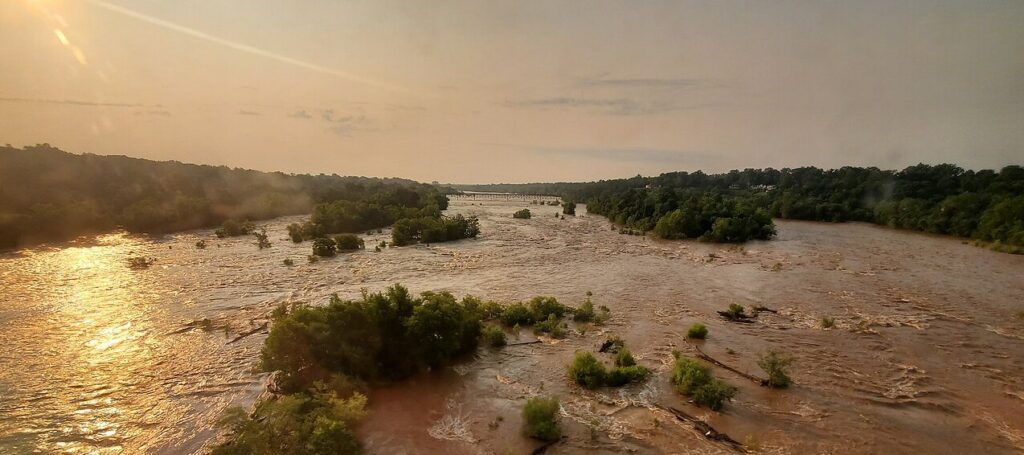
Click here to jump to a section below: Vital Facts | National Symbols | Articles
Vital Facts
FOUNDED: 200 million years ago (birth of the Atlantic Ocean and formation of the first rivers draining the proto-Appalachians)
AREA: 10,432 square miles (27,020 km2)
POPULATION: 2,618,070 (2022 estimate)
NATIONAL CAPITAL: Richmond
PROVINCES:
- Tidewater (Ahkynt)—capital: Norfolk
- Piedmont (Ahkontshuck)—capital: Lynchburg
- Highland (Paemotinck)—capital: Lexington
RIVER LENGTH: 444 miles (715 km) (including the tributary Jackson River)
RIVER SOURCE: Lantz Mountain near Hightown (Highland County)
HIGHEST POINT: 4,536’ (1,383 m), Little Ridge on Allegheny Mountain (Highland County)
LOWEST POINT: Sea level, Hampton Roads (Cities of Hampton and Norfolk
SPECIES: 9,952 documented on iNaturalist and eBird (6,009 animals, 2,760 plants, 1,128 fungi)
The following national symbols should be regarded as provisional, pending future votes by the citizens of Jamesland.
National Flag

The flag of Jamesland incorporates the following features:
Blue to represent the James River, widening as it nears the Chesapeake.
Three shades of green to represent the nation’s three provinces: a dark green for the pines of the Tidewater, a lighter green for the hardwoods and grasslands of the Piedmont, and a blue-green for the Blue Ridge and the Highland province beyond.
A cross of white to represent the nation’s major axes of transportation: east-west along the river, and north-south along the Fall Line.
A yellow circle to represent the setting sun which drew settlers’ attention toward the west, and a white circle to represent the moon’s influence on the tides of the lower river.
National Anthem: “Across the Blue Mountain”

This ballad, which describes two young lovers traveling “across the Blue Mountain to the Allegheny,” was first recorded in the late 1950s. The singer was Marybird McAllister (1877-1962), a resident of Brown’s Cove in Albemarle County, who had inherited the song via oral tradition; the recordist was Paul Clayton Worthington, a graduate student in folklore at the University of Virginia and an accomplished performer in his own right, who later became a leading figure in the Greenwich Village folk revival. “Across the Blue Mountain” is related to an eighteenth-century English tune called “High Germany,” but its storyline and local details must have been added by some forgotten early balladeer of Appalachia. Hardly a trace of it has been found outside of the isolated Brown’s Cove community.
To watch a recent performance of the song by folk duo Robin and Linda Williams, click here.
To read a longform essay about the unlikely meeting between McAllister and Worthington, and about the endangered natural and cultural heritage of the region, click here.
National Bird: Peregrine Falcon
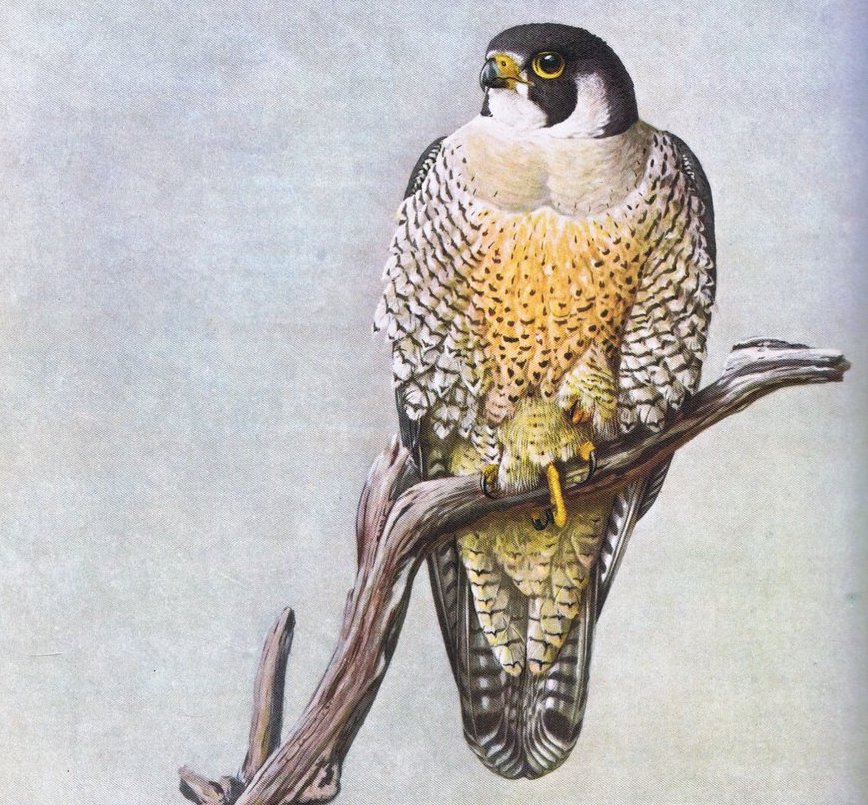
Scientific name: Falco peregrinus
The world’s fastest bird once nested on mountain cliffs in our region, but pesticides helped to eradicate it from the eastern United States by the 1960s. Since then an ambitious recovery program has brought the falcons back, and they now nest on Richmond’s skyscrapers and the high bridges of Hampton Roads.
To read more about this species and other birds of Jamesland, click here.
National Mammal: Virginia Northern Flying Squirrel
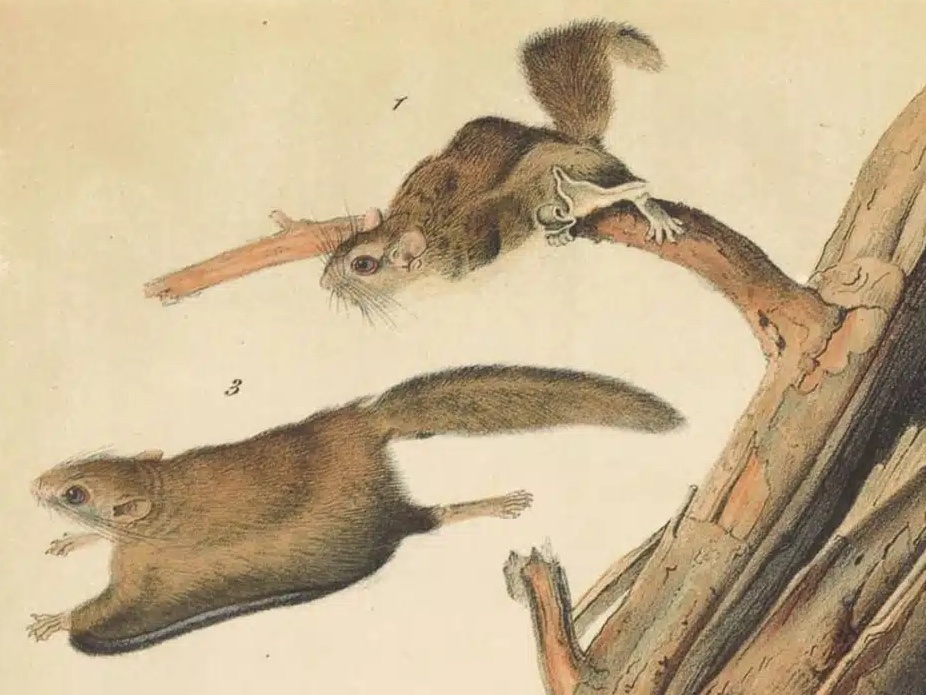
Scientific name: Glaucomys sabrinus fuscus
This subspecies occurs only in a small patch of the Allegheny Highlands above 3,300 feet, in eastern West Virginia and a tiny corner of Virginia, where it glides through spruce woods at night in search of truffles for its specialist diet. Although it has been removed from the endangered species list, its future remains uncertain.
To read more about this species and other mammals of Jamesland, click here.
National Reptile: Eastern Chicken Turtle
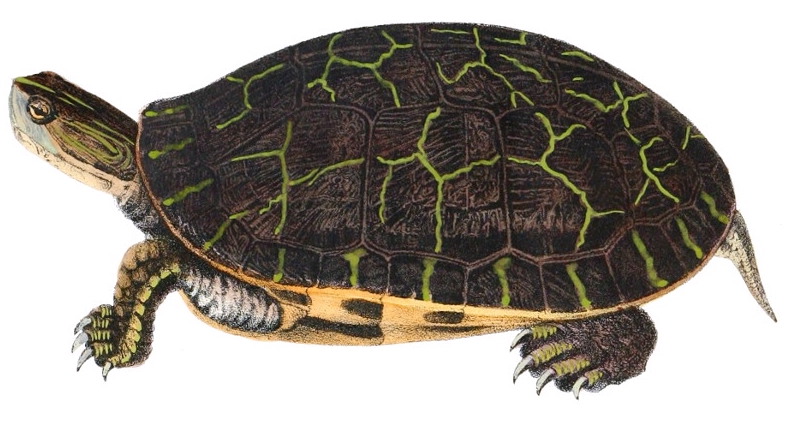
Scientific name: Deirochelys reticularia reticularia
This unusual turtle, with its super-long neck, carnivorous diet, and penchant for hibernation, was once thought to occur only in the Carolinas and southward. It was first found in Virginia in 1958, and may have just one surviving population in the state, at the Cat Ponds in Isle of Wight County.
National Amphibian: Big Levels Salamander
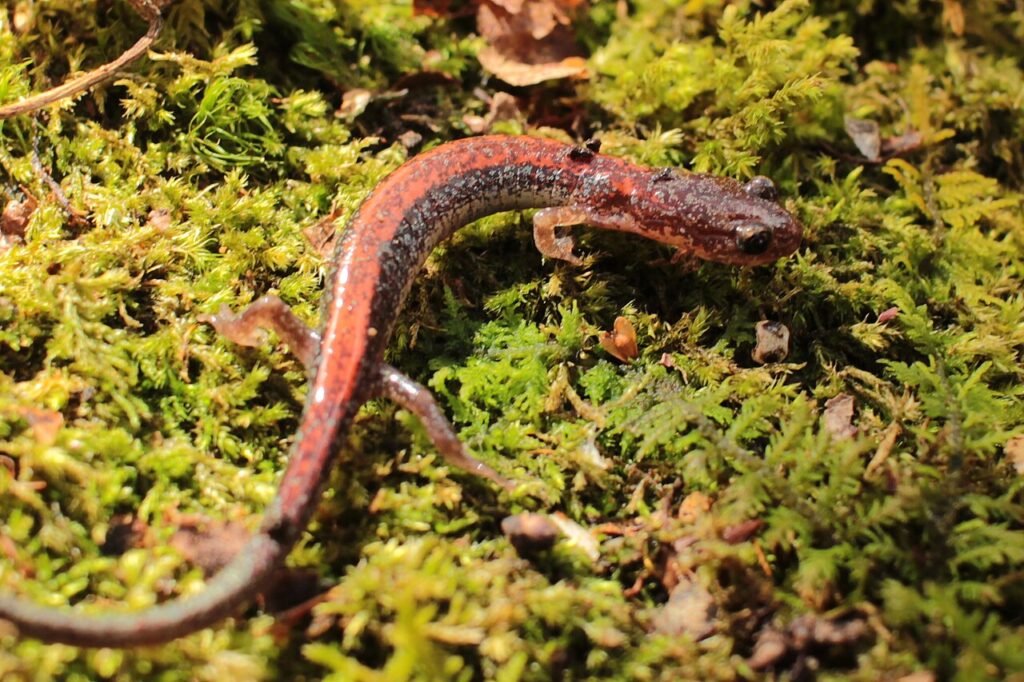
Scientific name: Plethodon sherando
Discovered in 2003, this is one of several salamander species restricted to tiny “sky islands” in the Appalachians. Its entire population lives within the thirty square miles of the high Big Levels plateau, making it vulnerable to climate change.
To read more about this species and other amphibians of Jamesland, click here.
National Fish: Longfin Darter
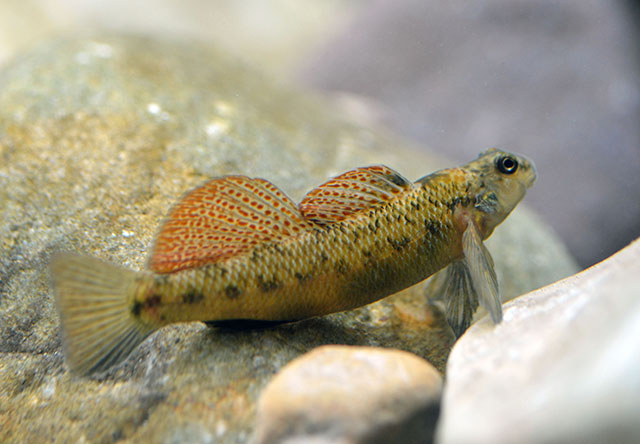
Scientific name: Etheostoma longimanum
Fully endemic to the upper James basin, this three-inch fish can be found darting along the bottom of cool, clear stream riffles. In the breeding season males’ dorsal fins flush bright orange as they compete to win females’ attention.
National Insect: Appalachian Grizzled Skipper
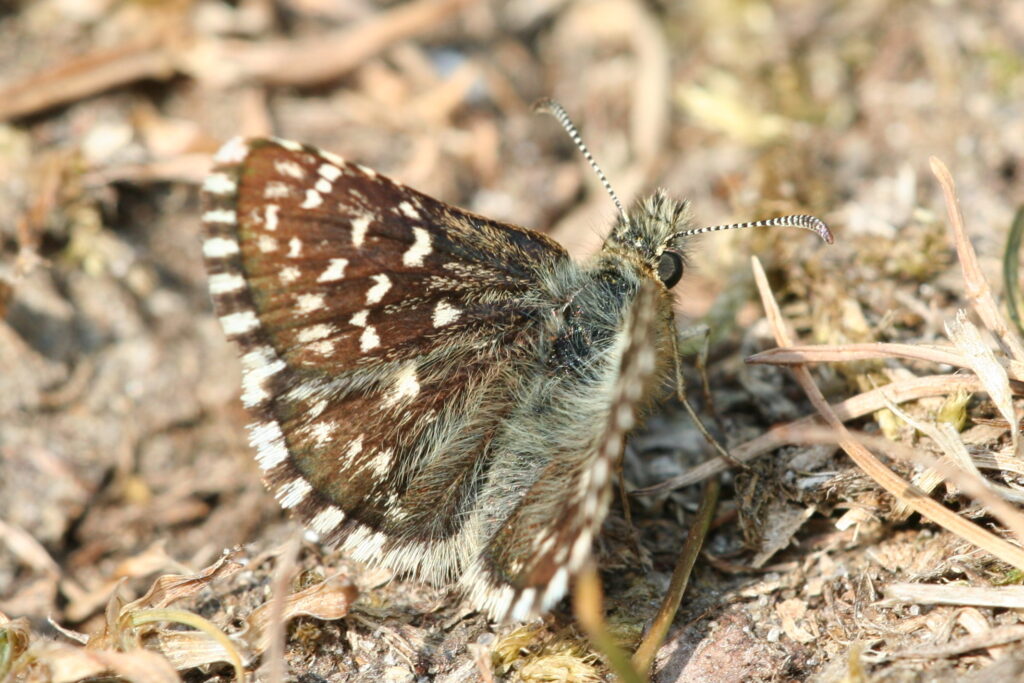
Scientific name: Pyrgus centaureae wyandot
Isolated from its relatives in the far north, this tiny denizen of mountain clearings was nearly wiped out by the spraying of pesticides to control the spongy moth. Its one remaining stronghold may be the shale barrens of Jamesland, where it flits low over the rocky ground searching for cinquefoil plants on which to lay its eggs.
To read more about this species and other insects of Jamesland, click here.
National Invertebrate: James River Spinymussel
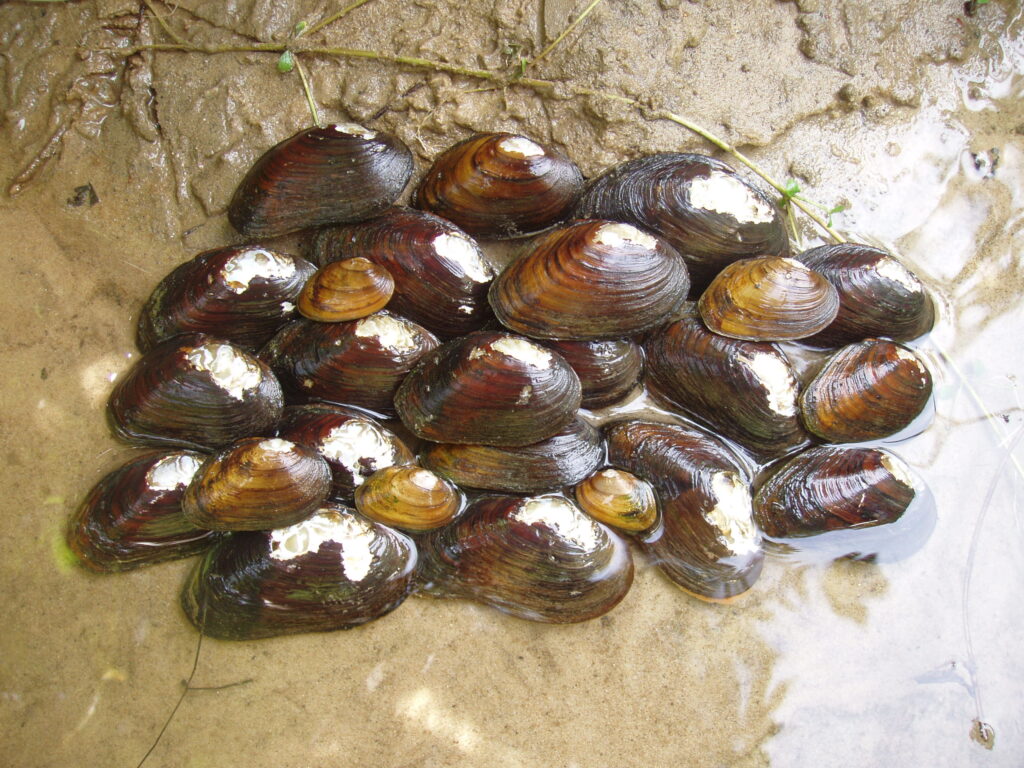
Scientific name: Parvaspina collina
This federally endangered mussel is almost entirely confined to the James River system, with another small group occurring in the upper Roanoke. A filter feeder that is highly sensitive to water quality, it produces parasitic larvae that must hitch a ride on certain species of fish. After its shrinking population had retreated to a few James headwater streams, in 2022 the river’s mainstem was finally healthy enough to allow mussels to be released there for the first time in decades.
National Wildflower: Millboro Leatherflower
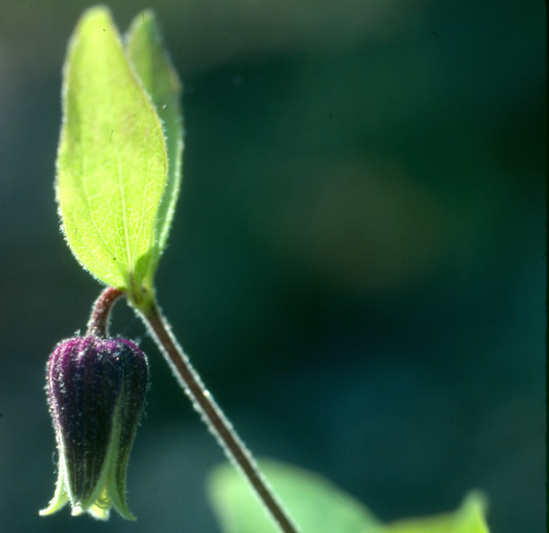
Scientific name: Clematis viticaulis
This tough plant is fully adapted to life in Jamesland’s shale barrens, where its entire global population is found. While a number of species specialize on these steep, rocky, droughty habitats, few have such a restricted range.
National Tree: American Chestnut
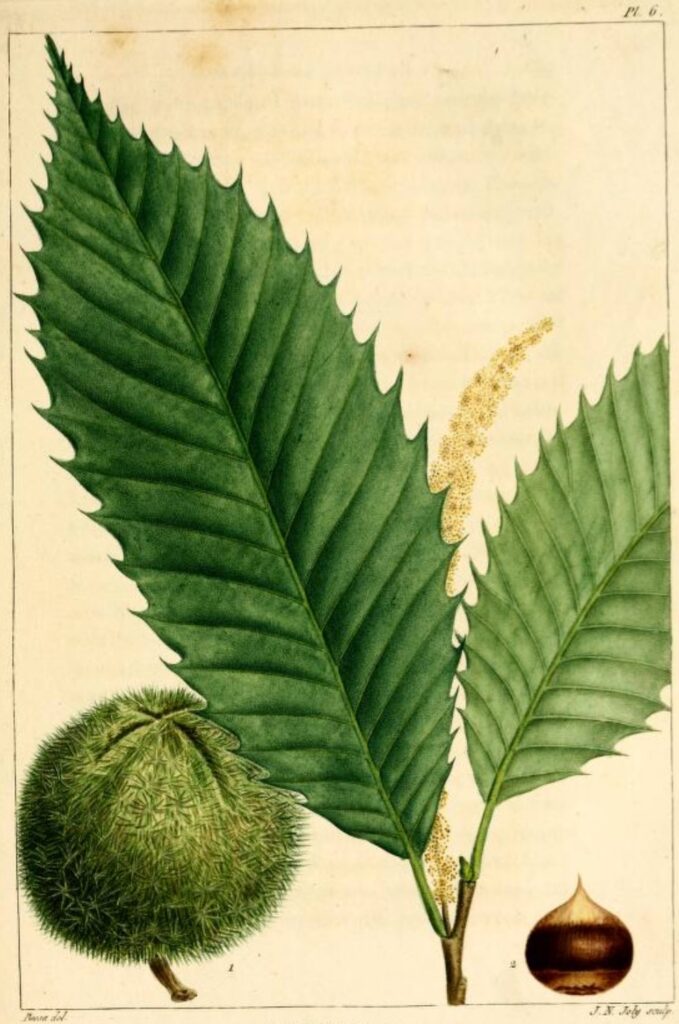
Scientific name: Castanea dentata
Once among the dominant trees of greater Appalachia, by 1950 this mighty species had been annihilated by the Asian chestnut blight. Millions of sprouts continue to grow, with nearly a quarter of those estimated to be in Virginia, only to succumb to the disease before maturity. Today our region is an epicenter of recovery efforts, with chestnuts bred for resistance now growing proudly in experimental stands like the Lesesne State Forest.
Articles
The collection of articles below is a work in progress, documenting the nation’s natural and cultural heritage and highlighting some of its most colorful stories.
Jamesland: An Overture – setting the stage for appreciating an exceptional place and its momentous history.
Ecology of Jamesland: An Introduction – a brief overview of the nation’s ecosystems, flora, and fauna.
Geology of Jamesland: An Introduction – a brief overview of the nation’s deep history, as recorded in its rocks and fossils.
Before the Colony – a brief overview of the human history of Jamesland prior to European settlement, and a map of some of its tribes, villages, and natural resources circa 1607.
Biggest, Tallest, Oldest – a celebration of the nation’s most remarkable trees.
400 Miles to the Sea – tracing the epic journey of a single drop of water, from the Allegheny headwaters of the James all the way to the Chesapeake Bay.
Marybird and the Songcatcher – on the unlikely story behind the national anthem of Jamesland, and the endangered cultural and natural heritage of Appalachia