
(Note: the following does not include insects, which are covered on their own separate page.)
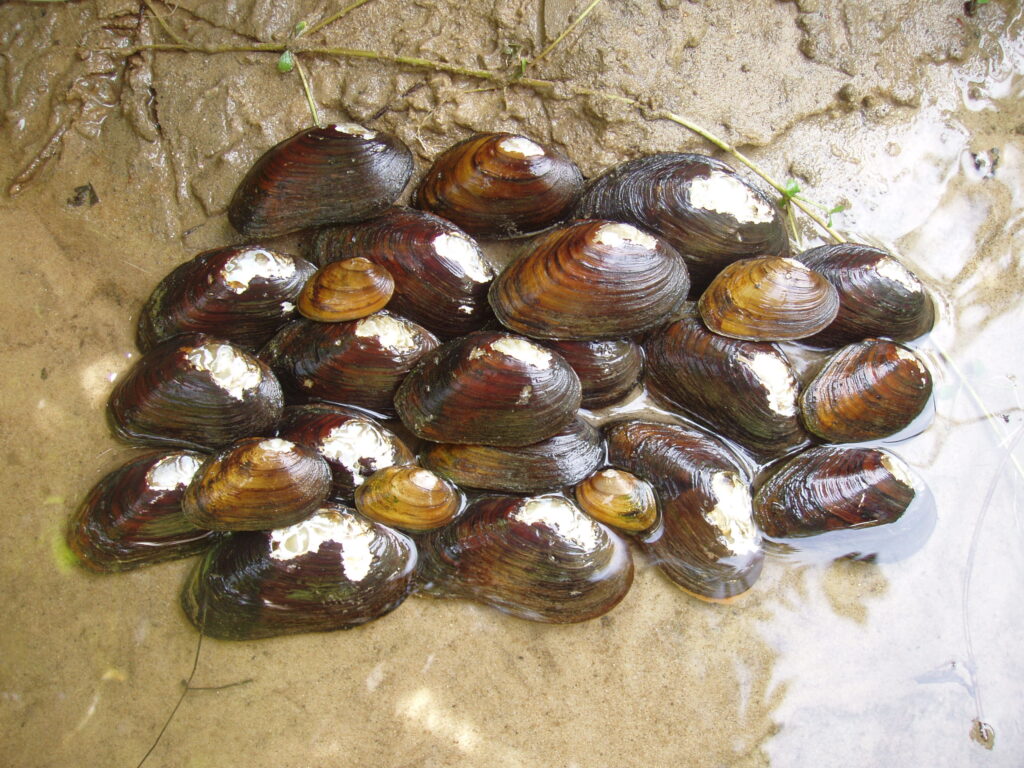
Freshwater mussels are not the most relatable animals. Although we may have come across their empty shells washed up on riverbanks, most of us have little concept of what goes on inside them—apart from a dim concept of an existence spent stuck to the bottom, passively filtering water. But this vastly undersells the intrigue of the mussel. Not only are these creatures among the longest-lived animals around, they turn out to lead lives that are full of variety, risk, and even subterfuge. They also serve as unsurpassed bellwethers for the health of our rivers, and that has been especially true of our local specialty, the James River spinymussel.
Southeastern North America is the global epicenter of these bivalves’ diversity, with the richest core of this hotspot extending into the Tennessee River tributaries of southwestern Virginia. Those streams contribute far more than their share to the Commonwealth’s list of roughly eighty mussel species, labeled with a host of colorful names like wartyback, spectaclecase, elephantear, pigtoe, sheepnose, sugarspoon, catspaw, snuffbox, pocketbook, heelsplitter, and pistolgrip. Yet even the comparatively mussel-poor James River basin can still boast about sixteen types, partitioning themselves by habitat from tidewater sloughs to Piedmont ponds to clear mountain creeks. Where multiple species overlap, the shape, color, and texture of their shells serve to distinguish them (and to lend them their picturesque names). But their diversity is far more than shell-deep. To understand what truly sets them apart, it helps to know something about the bizarre life cycle of the freshwater mussel.
Among the foremost challenges that face an animal like a bivalve, which spends its adult life in an essentially stationary position, is how to get itself or its progeny to a new place when the current one gets dirty or crowded. It is in tackling this challenge that freshwater mussels have deployed their most astonishing trick. Instead of simply spraying eggs into the water and hoping they float somewhere promising, these creatures take a more active approach by producing armies of specialized larvae called glochidia. These look something like translucent, near-microscopic copies of their parents, with a ghoulish twist: their miniature “shells” are armed with grappling hooks that lend them a Venus-flytrap character. The purpose of a glochidium is to drift through the water column until it encounters a host animal (typically a fish), whereupon it implants itself in a likely spot (typically the gills). If all goes according to plan, the host fish will form a cyst around its invader, which suits the latter just fine: this protective shell serves as a perfect shelter within which the young mussel can develop. After enjoying a free ride that may last for weeks or months, the hitchhiker drops off when it reaches a certain size, and tries its luck embedding itself in the sediment of its new home.
So goes the basic plan—but different species of mussel have devised a myriad of variations. While some species release their glochidia into the water indiscriminately, others package theirs into gelatinous “conglutinates” whose worm-like appearance is designed to tantalize fish. These Trojan-horse snacks may be free-floating, or, in the case of the orange nacre mussel, they may be attached to the parent by mucus strands to make them look like they’re swimming against the current. One species, the southern pocketbook, extrudes a larger “lure” from its mantle that startlingly resembles a minnow, complete with “fins” and eyespots; another, the rainbow mussel, has a lure shaped more like a crayfish, an illusion which the mollusk enhances by rocking back and forth to “walk” the fake creature. Yet another species, the snuffbox, supplements its trickery with outright assault, clamping its shell without warning on any overcurious fish and barraging it with a faceful of parasitic babies.
These strategic differences in what is tactfully known as “host recruitment” are complemented by other differences in mussels’ reproductive biology. For instance, some species are hermaphroditic and capable of fertilizing themselves, while in others the sperm from males must float downstream and be inhaled by females. Such distinctions help to explain why these creatures have diversified so impressively since their basic blueprint was laid down—which, according to the fossil record, took place as far back as the Triassic. That freshwater mussels have been around, in more or less their current form, for some two hundred million years is a testament to how well their ways of life have served them. Unfortunately, over the past few hundred years their situation has taken an abrupt turn for the worse.
The writings of the Jamestown settlers provide glimpses of the original abundance of mussels and other bivalves, as well as portents of the threats that awaited the creatures. In George Percy’s 1625 reminiscences of their first arrival in the New World, he mentions that the colonists were astounded to find mussels and oysters that “lay on the ground as thicke as stones…wee opened some, and found in many of them Pearles.” Shortly thereafter they were treated to a demonstration of the art of pearl-diving by one of the region’s Algonquian tribes, and were duly impressed by the chain of pearls that adorned the neck of those tribes’ chief Powhatan. For a colony that would soon become increasingly desperate for sources of income, the pearls of the Chesapeake held a considerable allure.
The pearls of these early reports likely belonged to the oysters rather than the mussels; and in any case the latter probably referred to Geukensia demissa, a “true mussel” associated with salt marshes that is unrelated to the pigtoes and pocketbooks found further upstream. Yet before long it was discovered that North America’s freshwater mussels were also capable of producing pearls, encasing irritants within their shells with nodules of the iridescent stuff called nacre. The colonists could find no way of commercially exploiting these, a project that would have to wait until circumstances conspired in the nineteenth century. It was in 1857 that a spectacular twenty-three-carat pink gem turned up inside a mussel from New Jersey, landing in the collection of the French Empress and launching what became known as the Pearl Rush. Streams with known shell beds from New England to Wisconsin to Arkansas were suddenly overrun by fortune-seekers “pollywogging” for mussels (a fine art that amounts to shuffling one’s bare feet through the mud). The discarded shells and denuded beds produced by these methods vastly outweighed their modest bounty of precious stones, and mussels were all but extirpated from many waterways in the process.
A second wave of exploitation followed as manufacturers in the Midwest found the mother-of-pearl (nacre) from mussel shells to be a rich source of shiny material for buttons. The ensuing carnage reached a staggering scale, with some sixteen million pounds of shell harvested in a single year and state (Wisconsin in 1899). The invention of plastics eventually put an end to the pearl-button craze, and the emergence of the cultured pearl industry in Japan put an end to the age of the pollywogger. Although that industry still depends on mass exports of shell from places like Alabama and Tennessee, the Endangered Species Act has at least protected the more vulnerable species from its depredations.
The bad news is that direct exploitation of mussels has been replaced by threats that are more insidious and no less dire. The wholesale damming of rivers has wiped out stretches of flowing-water habitat, blocked dispersal of glochidia, and upended the natural cycling of nutrients. Deforestation and wetland destruction have removed the natural buffers that keep delicate mussel gills from being clogged by sediment, while runoff from cities and industrial farms comes laden with pesticides, pharmaceuticals, and other toxic chemicals. It has never been harder to make a living as a filter feeder in America’s rivers. The result has been the extinction of at least twenty of the continent’s freshwater mussel species, with seventy percent of the species that remain meeting some standard of endangerment or vulnerability. Perhaps no group of animals in the world is more at risk.
This affects more than the mussels. The filtration services provided by these so-called “livers of the rivers” improve habitat for countless other aquatic plants and animals, qualifying them as keystone species in their ecosystems. So the stories of these unsung heroes have great implications for the health of the planet. There is no better example than that of the James River spinymussel, which, as a denizen of a single river system that happened to be the very first one subjected to Anglo-American civilization, has been under the gun for centuries.
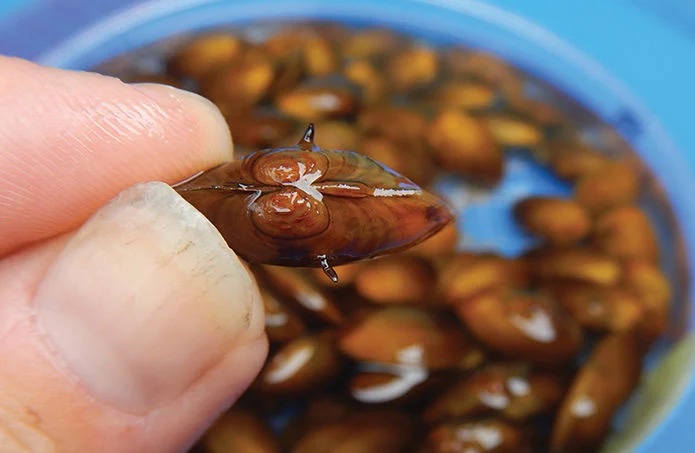
Among a tribe not known for its looks, Parvaspina collina stands out as unusually flashy. Armed with one or two sharp protuberances (“spines”) on each shell during its juvenile phase, it loses these with age but gains a vivid orange hue to its mantle and foot. These oddities have vexed mussel taxonomists since it was first discovered in the Calfpasture River in 1836, and the species has been shuffled around into no fewer than six different genera. It shares its current one with just a single other species, the equally rare spinymussel of North Carolina’s Tar River basin.
Much is still unknown about the life history of P. collina. (For example: do the spines serve some function?) We do know that it shares with other mussels a filter-feeding lifestyle and a taste for tiny algae and floating detritus. We also know that it releases its glochidia in June and July, each female spewing forth some thirteen thousand offspring packaged into wormlike conglutinates about a centimeter in length. Minnowlike native fish such as the redbelly dace, bluehead chub, and rosefin shiner seem to be the most frequent hosts. The spinymussels are surprisingly relaxed about their habitat requirements from what we can tell, occurring in both sand and gravel substrates and in both still pools and swift channels. Yet the dramatic retreat of its range over the past century indicates a severe sensitivity to something in the modern environment. Once found throughout the James system in Piedmont and Highland provinces, by the 1980s the species had vanished from all but a handful of relatively untouched mountain streams: Moormans, Mechums, and Pedlar rivers on the east flank of the Blue Ridge, and Catawba, Craig, and Potts creeks in the Ridge and Valley. (Records of the mussel in the upper Dan River system, technically outside Jamesland, may not be quite the disproof to its endemic status that they seem to be. These records fit with the hypothesis that certain headwaters of the Dan once belonged to the James before they were pirated in what geologists call stream capture.)
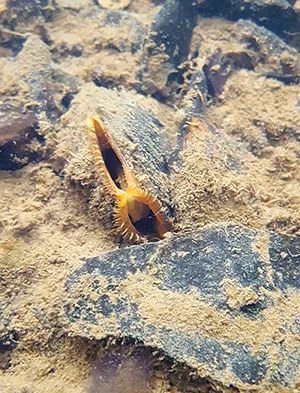
One thing these streams share is that their watersheds remain in a relatively natural state, with less alteration by dams and more intact forest cover. Pollution and sedimentation are thus at a more manageable level, and the mussels’ host fish can travel more freely to sustain the mollusks’ populations. But there is another factor that has not yet been mentioned. Over the last half-century P. collina has had to contend not only with degrading habitat, but also with an aggressive interloper that threatens to shoulder the native mussel out of what habitat remains.
The Asian clam, Corbicula fluminea, appeared on the scene in the James River around 1971. First detected near Hopewell, by just thirteen years later it had spread all the way upstream to Craig Creek. Smaller than most of our native mussels, this species has several traits that make it a brutally effective invader of modern, disturbed American waterways. It grows fast, breeds young, and tolerates a wide range of conditions. It also happens to be reproductively self-reliant, fertilizing itself as a hermaphrodite and broadcasting larvae in vast quantities without needing to wait for a fish host to cruise by. This turned out to be such a winning combination that within a few years of its appearance in the James, it had reached densities in some spots in the river of up to a thousand clams per square meter. Studies showed that the clams were capable of hoovering as much as seventy percent of the available phytoplankton from infested stretches of water, putting their native neighbors in a bind.
The onslaught of the clams tipped the spinymussel’s situation over from concern into crisis. In 1988 it was added to the federal endangered species list, and at the time few would have been shocked to see the species follow so many of its relatives into oblivion. But in an inspiring case of the triumph of the will, a few dedicated wildlife officials refused to allow that to happen. Working at the Harrison Lake National Fish Hatchery in Charles City County, they managed to crack the delicate code of propagating spinymussels in the lab. Reintroducing some of these lab-reared mussels to James River tributaries proved to be a tentative success, and over the years the indicators of the river’s health kept trending upward: water quality had rebounded from its mid-century nadir, and the worst phase of the clam invasion seemed to have passed. It was time to take the next step.
In the summer of 2022, the team at last released some two thousand young spinymussels into the James’ mainstem, where the species had not been seen in fifty years. The little shells were tagged with numbers for future checkups, and several hundred were fitted with transponders so that their adventures could be followed remotely. In keeping with the mussels’ unassuming nature, the event came with little fanfare. But the river’s ability once again to support one of its flagship—and most sensitive—species was a tremendous milestone in its environmental history.
The spinymussel is far from the only invertebrate that is uniquely tied to Jamesland. The caves of the Highland karst region constitute an archipelago of sorts that has encouraged a florid radiation of species. A few of our endemic and near-endemic cave species are listed here; all share some degree of adaptation to life in the darkness, such as the loss of eyes and pigment:
- Rockbridge County cave planarian (Sphalloplana virginiana) [a type of flatworm] – found only in Showalter Cave, Rockbridge County
- Buck Hill cave spider (Islandiana muma) – found in Buck Hill Cave, Rockbridge County; also in one other cave in Alabama
- Porters Cave pseudoscorpion (Kleptochthonius anophthalmus) – found only in Porters Cave, Bath County
- Cerberus cave millipede (Pseudotremia cerberus) – found only in Wares Cave, Alleghany County
- Alleghany County cave centipede (Nampabius turbator) – found only in Lowmoor and Island Ford caves, Alleghany County
- Catawba Murder Hole springtail (Pygmarrhopalites caedus) – found only in Catawba Murder Hole, Botetourt County, and Starr Chapel Saltpetre and Little Starr Chapel caves, Bath County
- Burnsville Cove cave amphipod (Stygobromus conradi) [a tiny shrimplike crustacean] – found in caves in the Burnsville Cove area of Bath and Highland counties
- Natural Bridge cave isopod (Caecidotea bowmani) [a pillbug-like crustacean] – found only at Natural Bridge, Rockbridge County, and Purgatory Cave, Botetourt County
Even on the surface, this region provides fertile ground for invertebrate diversity. Limestone soils tend to be hotspots for land snails, and we have several tiny, delicately spiraled species–the shaggy coil (Helicodiscus diadema), rubble coil (H. lirellus), and talus coil (H. triodus)–that are restricted to parts of Bath, Alleghany, and Rockbridge counties. The first-mentioned of the three is the rarest, documented only from the limestone slopes of the Falling Spring valley.
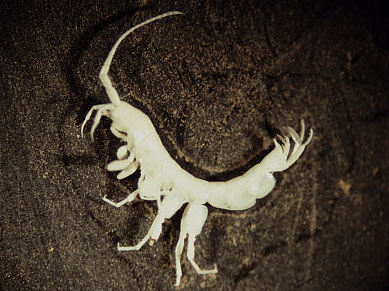
Two hundred miles east, another remarkable invertebrate has found a very different niche. Like its troglodyte cousins, the tidewater interstitial amphipod (Stygobromus araeus) is a diminutive, eyeless, translucent shrimplike creature. Yet when it was discovered in 1944 it was not in a cave, but in a Coastal Plain ravine near the mouth of the Nansemond River. The species turns out to live exclusively in the groundwater between sand grains, in saturated soils where aquifers approach the surface. Although it has now been reported from Virginia’s Middle Peninsula as well as just across the state line in North Carolina, its stronghold appears to be along the James River in Norfolk, Suffolk, and Isle of Wight counties.